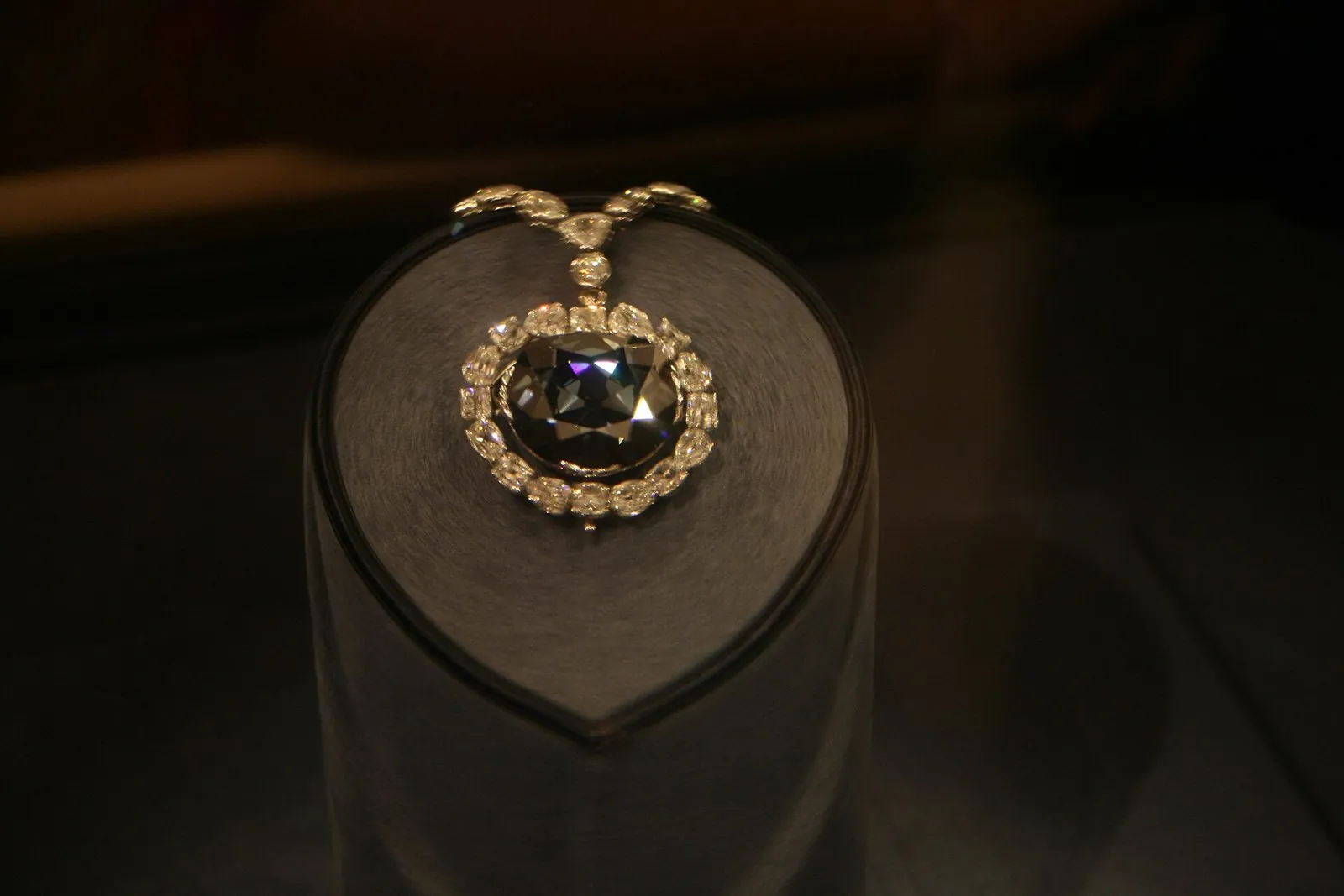
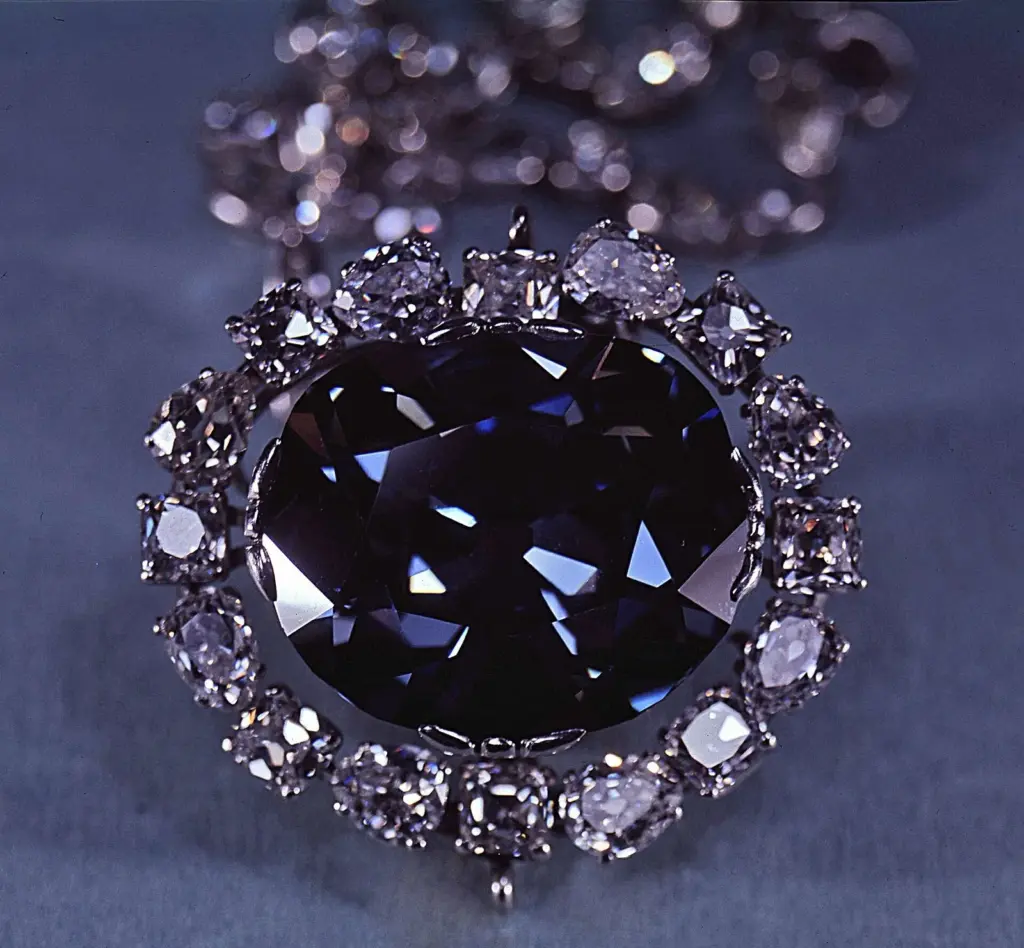
The first surprise about the Hope Diamond is how small it is: about an inch long, a dark steel-blue stone ringed by white diamonds, sitting alone in a glass case on the second floor of the National Museum of Natural History. The second is how many people will be standing in front of it with you. It weighs 45.52 carats, it has passed through the hands of a French king, a London banker and a Washington socialite, and it reached the Smithsonian in 1958 in a plain brown package sent by registered mail, with $2.44 in postage. Seeing it is free, needs no pass, and takes ten minutes if you time it right. It’s one of the most famous objects in any of the Smithsonian museums, and this page covers both the story and the logistics.
Quick answer: The Hope Diamond is on permanent display in the Harry Winston Gallery of the Hall of Geology, Gems, and Minerals, on the second floor of the Smithsonian’s National Museum of Natural History on the National Mall. The museum is free, needs no timed pass and is open 10 a.m. to 5:30 p.m. daily except December 25. To beat the crowd, arrive at opening and go straight upstairs.
Last updated September 30, 2026. Location, hours, entry rules and the diamond’s history were checked that day against the Smithsonian’s own websites, including the National Museum of Natural History and the National Postal Museum.
- Where: Harry Winston Gallery, Janet Annenberg Hooker Hall of Geology, Gems, and Minerals, second floor, National Museum of Natural History.
- Cost: free; no timed pass needed (as of September 2026).
- Hours: 10 a.m. to 5:30 p.m. daily; closed December 25.
- Size: 45.52 carats, blue from trace amounts of boron.
- At the Smithsonian since: November 10, 1958, a gift from the jeweler Harry Winston.
On this page: At a glance | Where to see it | Beating the crowd | By the numbers | History | The curse | Sent by mail | Other gems | With kids | Plan your visit | FAQ
The Hope Diamond at a glance
| What you need to know | Details (as of September 2026) |
|---|---|
| Museum | Smithsonian’s National Museum of Natural History, 10th Street and Constitution Avenue NW, on the National Mall |
| Gallery | Harry Winston Gallery, Hall of Geology, Gems, and Minerals, second floor |
| Cost | Free |
| Pass | None needed; walk in |
| Hours | 10 a.m. to 5:30 p.m. daily; closed December 25 |
| Entrances | Madison Drive (the Mall side) and Constitution Avenue at 10th Street |
| Metro | Smithsonian or Federal Triangle (Blue, Orange, Silver lines), each about a 5- to 10-minute walk |
| Time needed | 10 minutes for the diamond; 45 minutes to an hour for the whole gem and mineral hall |
| Best time | 10 a.m. opening, or after 4 p.m. |
Where to see the Hope Diamond
The Hope Diamond lives in the Harry Winston Gallery, the centerpiece room of the Janet Annenberg Hooker Hall of Geology, Gems, and Minerals, on the second floor of the National Museum of Natural History. It’s the centerpiece of the National Gem Collection, and it’s on permanent display, so unlike many museum objects it isn’t rotated in and out of storage.
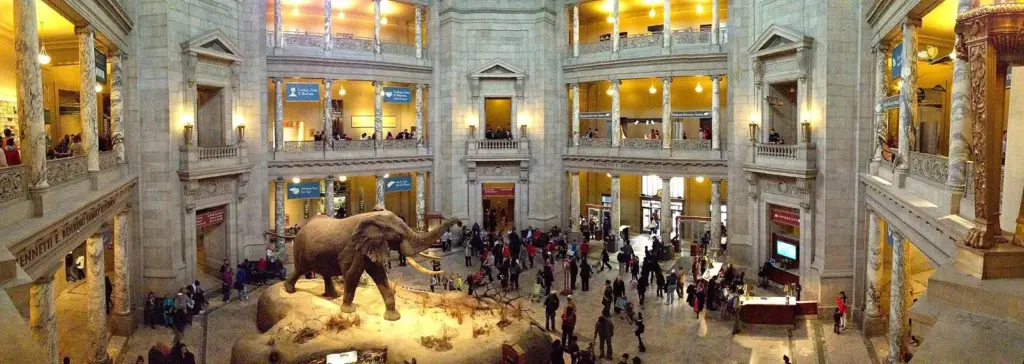
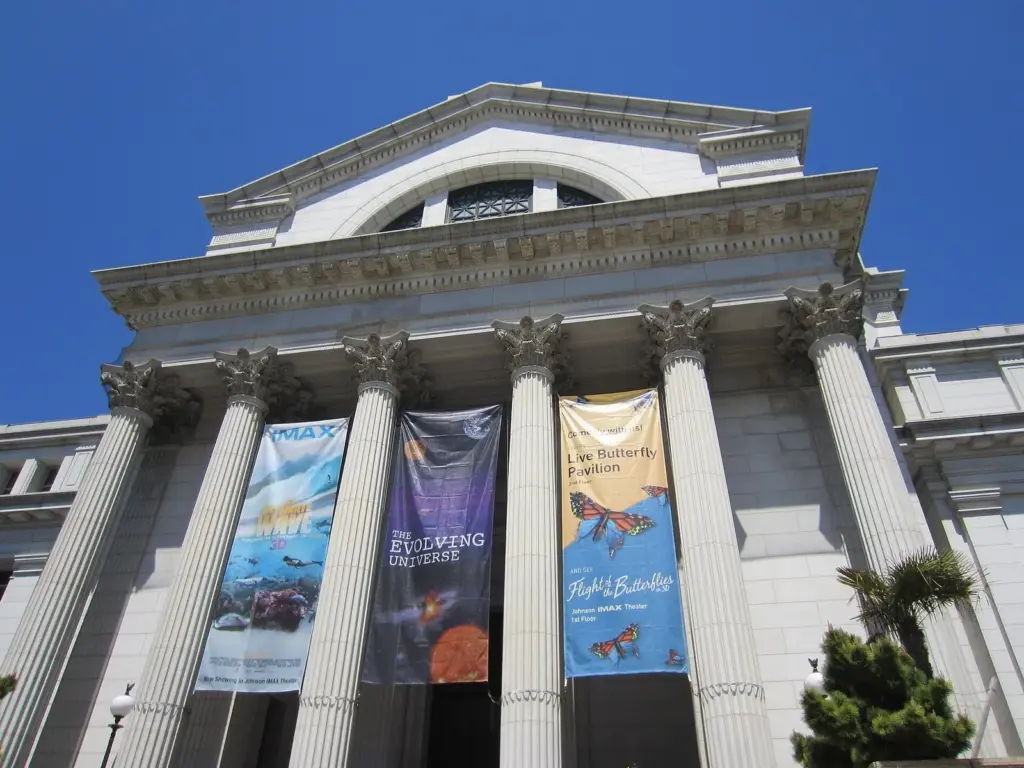
The museum has two public entrances: Madison Drive, on the National Mall side, and Constitution Avenue at 10th Street. From either one, head for the rotunda (you can’t miss the African elephant), then follow the signs up to the second floor and the gems and minerals hall. The diamond sits in its own case in the middle of the gallery, which means the crowd gathers in a ring around it rather than in a line. Be patient and work your way to the glass; the people at the front rarely stay more than a minute or two.
Everything in the museum is free, with no timed pass, as of September 2026. The only thing standing between you and the diamond is the security screening at the door, which is the same airport-style check every Smithsonian museum uses.
How to see the Hope Diamond without a crowd
The Hope Diamond draws a crowd all day, but it moves in predictable waves. Most visitors start on the first floor, with the rotunda elephant, the mammals and the dinosaurs of the fossil hall, and reach the second floor later in the morning. That gives you a window.
- Go at opening and go upstairs first. Be at the door before 10 a.m., clear security and walk straight to the second floor. For the first half hour, you’ll share the case with a handful of people instead of a few dozen.
- Or go late. After about 4 p.m. the school groups and tour buses have gone, and the gem hall thins out before the 5:30 p.m. close.
- Pick your season. Weekdays in fall and winter are the calmest. From March through May, school field trips fill the museum on weekday mornings, and summer weekends are busy all day.
- Use the far side of the case. Because the case stands free in the middle of the room, the side away from the main entrance to the gallery is often less crowded.
If you arrive at midday and the crowd is ten deep, don’t give up: see the rest of the gem hall and loop back in 20 minutes. The crowd around the case turns over constantly.
The Hope Diamond by the numbers
| Fact | Figure |
|---|---|
| Weight today | 45.52 carats |
| Color | Deep grayish blue, from trace amounts of boron |
| Under ultraviolet light | Glows red-orange (phosphorescence) |
| Likely origin | The Kollur mine, Golconda, India |
| Tavernier’s rough stone | 112 3/16 carats |
| The “French Blue,” recut 1673 | 67 1/8 carats |
| Price Evalyn Walsh McLean paid, 1911 | $180,000 |
| Donated to the Smithsonian | November 10, 1958 |
| Postage to mail it | $2.44, for a 61-ounce package |
| Total mailing fee, with insurance | $145.29, covering about $1 million |
That red-orange glow is real, but you won’t see it in the case. It appears only after the stone is exposed to ultraviolet light, and the display lighting is ordinary.
A short history of the Hope Diamond, from India to the Mall
Tavernier and the French Blue
The documented story begins in the 1660s with Jean-Baptiste Tavernier, a French merchant who traveled to India and bought a large blue diamond of 112 3/16 carats, most likely from the Kollur mine in Golconda. In 1668 he sold it to King Louis XIV, along with 14 other large diamonds and a number of smaller ones. In 1673 the court jeweler, Sieur Pitau, recut it into a 67 1/8-carat stone. The royal inventories described its color as an intense steely blue, and it became known as the “Blue Diamond of the Crown,” or the “French Blue.”
Stolen, recut and renamed
The French Blue was stolen in 1792, during the unrest of the French Revolution, and it vanished. A blue diamond of the present size, 45.52 carats, surfaced in London in 1812, almost certainly cut from the stolen French Blue. It came to belong to Henry Philip Hope, a London banker and gem collector, and his name stuck.
Cartier and the McLeans
In 1910 the Paris jeweler Pierre Cartier met Ned and Evalyn Walsh McLean, a wealthy Washington couple, on their vacation in Paris, and set about selling them the diamond. In 1911 Evalyn Walsh McLean, a Washington socialite whose husband’s family owned The Washington Post, bought it for $180,000. She kept it for the rest of her life and wore it often.
Harry Winston, and the gift
After McLean’s death, the New York jeweler Harry Winston bought the diamond from her estate in 1949. For the next ten years his company showed it at exhibitions and charity events around the world, including as the star of its Court of Jewels show. Then, on November 10, 1958, Winston gave it to the Smithsonian Institution. It became the museum’s premier attraction almost immediately, and it has been the star of the gem collection ever since.
The owners, in order
| When | Who had it |
|---|---|
| 1660s | Jean-Baptiste Tavernier, French merchant, buys the rough stone in India |
| 1668 | King Louis XIV of France; recut into the French Blue in 1673 |
| 1792 | Stolen from the French crown during the Revolution |
| 1812 | Resurfaces in London at its present size |
| By the 1830s | Henry Philip Hope, London banker and collector, who gives it its name |
| 1910 | Pierre Cartier, the Paris jeweler, pitches it to the McLeans |
| 1911 to her death | Evalyn Walsh McLean of Washington, who pays $180,000 |
| 1949 to 1958 | Harry Winston, the New York jeweler, who buys it from her estate |
| 1958 to today | The Smithsonian Institution |
Why it’s smaller than it used to be
Every time a diamond is recut, it loses weight, and this one has been recut twice. Tavernier’s rough stone weighed 112 3/16 carats. The French Blue cut from it in 1673 weighed 67 1/8 carats. The stone that surfaced in London in 1812 weighed 45.52 carats, which is what you see today. Put together, that’s roughly 60 percent of the original weight gone, ground away over two centuries to change its shape, improve its brilliance and, after 1792, make a stolen royal jewel unrecognizable. The recutting is also why historians spent so long arguing over whether the Hope and the French Blue were the same stone.
The Hope Diamond curse: legend versus record
You’ll hear that the Hope Diamond is cursed: that it brings ruin to whoever owns it. The Smithsonian’s own history of the stone is blunt about where much of that came from. Pierre Cartier, it says, likely embellished the stories as a sales tactic when he pitched the diamond to the McLeans in 1910, presenting a dramatic provenance that included a curse bringing bad luck to all who owned it.
It didn’t put Evalyn Walsh McLean off. She told Cartier that objects that brought bad luck to others brought good luck to her, and bought it anyway. The years that followed were hard ones, and they’re the core of the legend: her husband eventually died in a mental institution, her eldest son was killed in a car accident, and her daughter died of an overdose of sleeping pills. Those losses were real. Whether a stone caused them is another matter, and the record points to a jeweler who understood that a good story sells.
Our view: the curse is one of the most successful sales pitches in history, and it’s still working. It’s a big part of why people cross the Mall to see a stone about an inch long. If you want to go deeper, the Smithsonian’s Sidedoor podcast devoted an episode to the curse, and Richard Kurin’s book Hope Diamond: The Legendary History of a Cursed Gem, published by the Smithsonian, is the full account.
The Hope Diamond went to the Smithsonian by mail
This is the best story in the case, and it’s true. Harry Winston didn’t send the diamond by armored truck. On the morning of November 8, 1958, it left New York by registered first-class mail, then considered the safest way to ship valuables, in a plain brown paper package. According to the National Postal Museum, the package weighed 61 ounces. The postage came to $2.44; the total fee was $145.29, with the remaining $142.85 paying for about $1 million of insurance. Two days later, on November 10, the gift was made official.
The wrapper, with its stamps and postmarks, is now in the collection of the Smithsonian’s National Postal Museum, next to Union Station. It’s a fitting afterlife for a piece of brown paper that once carried a diamond insured for $1 million.
Other famous gems in the same hall
Most visitors see the Hope Diamond and leave. Don’t. The Hall of Geology, Gems, and Minerals shows about 2,500 minerals and gems, and several of the stones around the Hope are famous in their own right. Four to look for, as of September 2026:
The Logan Sapphire
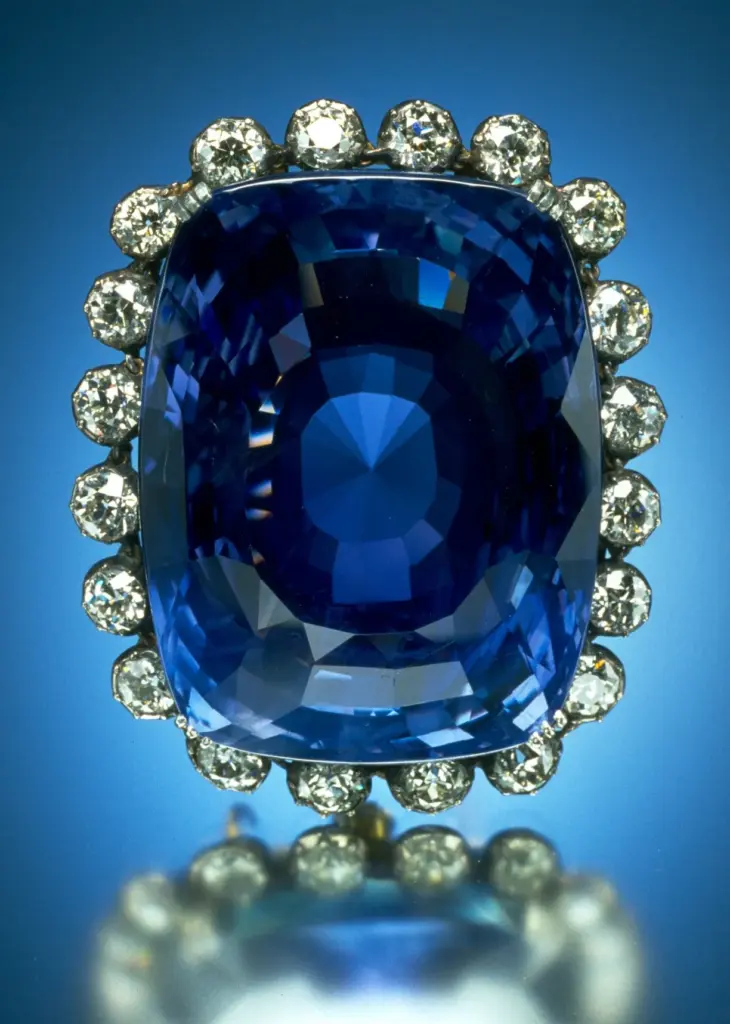
At 423 carats, the Logan Sapphire is one of the largest faceted blue sapphires in the world and the heaviest mounted gem in the National Gem Collection. It was cut from a crystal mined in Sri Lanka and sits in a brooch framed by 20 round brilliant-cut diamonds totaling about 16 carats. Next to it, the Hope looks modest.
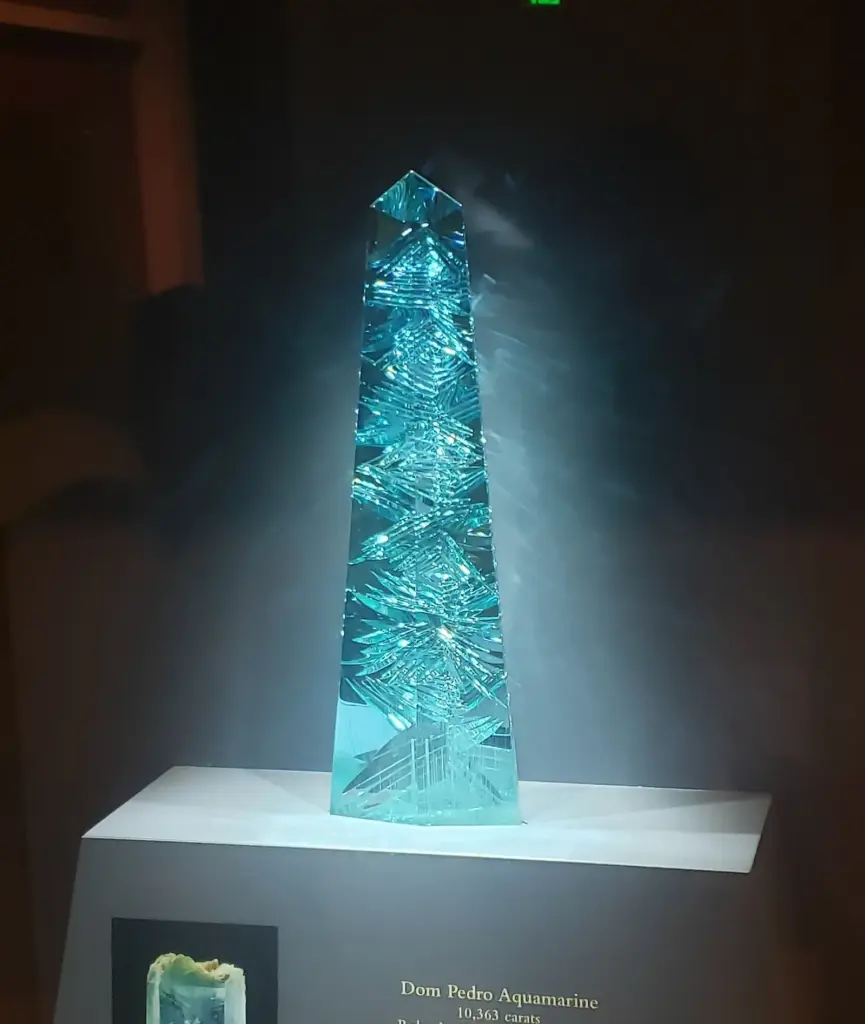
The Dom Pedro aquamarine
The Dom Pedro is the world’s largest faceted aquamarine: a 10,363-carat obelisk standing 13.75 inches tall, carved with facets on its back that throw light through the stone. It’s the one children stop at, because it looks like something out of a science fiction film.
The Star of Asia
A star sapphire, one of the gems the museum singles out in the hall. Look for the six-rayed star that floats across its domed surface when the light hits it; move your head and the star moves with you.
The Hooker Emerald Brooch
Another of the hall’s named highlights, and the green counterpoint to all that blue. Look for it among the jewelry cases around the Harry Winston Gallery.
Beyond the named stones, the hall covers minerals, meteorites and the geology that makes gems possible. Allow 45 minutes to an hour if rocks interest you at all; it’s one of the better-designed galleries in the museum.
A 90-minute Natural History visit built around the Hope Diamond
If the diamond is your reason for coming, this order gets you the museum’s best-known sights without backtracking or fighting the midmorning crowd at the case:
- 10:00 a.m. Enter on Madison Drive, clear security and walk straight through the rotunda, past the elephant, and up to the second floor.
- 10:10 a.m. The Hope Diamond, while the room is still quiet. Give it a slow loop around the case.
- 10:20 a.m. The rest of the Harry Winston Gallery and the gem hall: the Logan Sapphire, the Dom Pedro aquamarine, the Star of Asia and the Hooker Emerald Brooch.
- 10:50 a.m. The minerals, meteorites and geology galleries beyond the gems, if rocks hold your interest.
- 11:05 a.m. Back downstairs to the Hall of Fossils: Deep Time, which by now is busy but worth it.
- 11:30 a.m. Leave by the Constitution Avenue doors or cross back through the rotunda to the Mall.
If you only have 30 minutes, cut it to the rotunda, the diamond and the Dom Pedro. If you have all day, the National Museum of American History is next door, and lunch on the Mall is a short walk away.
Seeing the Hope Diamond with kids
The Hope Diamond is an easy win with children, as long as you set expectations: it’s small, and the crowd around it is made of adults’ elbows. Lift small children at the side of the case rather than the front, and keep the visit short. Then give them the rest of the hall: the Dom Pedro aquamarine, the giant crystals and the meteorites usually hold attention longer than the diamond does.
Pair it with the fossil hall on the first floor, the museum’s Hall of Fossils: Deep Time, which holds about 700 fossils, and the elephant in the rotunda, and you have a museum morning most families remember. For the rest of a family trip, including the zoo and museums built for small children, see our guide to things to do in DC with kids.
Planning your visit to the Natural History Museum
Plan it: open 10 a.m. to 5:30 p.m. daily, closed December 25. Free, with no timed pass, as of September 2026. Metro: Smithsonian (Blue, Orange and Silver lines), about a 5- to 10-minute walk from the Mall exit, or Federal Triangle (same lines), about the same. Security screening at the door, with knives of any kind (including pocket knives) prohibited. Allow 10 minutes for the diamond, an hour for the gem hall and two to three hours for the museum’s highlights. Best for: first-timers, families, rainy days.
A few more things worth knowing:
- Entrances: Madison Drive on the Mall and Constitution Avenue at 10th Street. If the Mall-side line is long, try Constitution Avenue.
- Getting around the Mall: the DC Circulator bus that used to loop the Mall ended on December 31, 2024, and nothing has replaced it. Walk between museums, or use Metrobus routes on the streets that border the Mall. From the Washington Monument, the museum is roughly a 10-minute walk east along the Mall.
- Accessibility: the museum’s floors are connected by elevators as well as stairs, so the second-floor gem hall is reachable without climbing; ask at the information desk in the rotunda if you need directions.
- Shutdowns: as a federally funded museum, Natural History closes during a government shutdown. In fall 2025 the Smithsonian closed its museums from October 12 until mid-November. As of September 2026, the government is funded through December 11, 2026; check the museum’s website if you’re visiting after that.
- Pair it with: the National Museum of American History next door, also free and walk-in, or the National Gallery of Art across the Mall.
The rest of the museum, from the fossil hall to the ocean hall, deserves its own visit plan; the Hope Diamond is the headline, not the whole show. Our complete guide to the free Smithsonian museums covers how Natural History fits into a Mall day, with hours and pass rules for every museum side by side.
What to skip
- Midday on a spring weekday. School groups arrive in waves from March through May. Come at 10 a.m. or after 4 p.m.
- Expecting it to glow. The famous red phosphorescence only shows after ultraviolet light, not in the display case.
- Leaving after the diamond. The Logan Sapphire and the Dom Pedro are a few steps away and far less crowded.
- Paying anyone for “tickets.” The museum is free, with no pass, and the diamond costs nothing to see.
Hope Diamond FAQ
Where is the Hope Diamond?
It’s on permanent display in Washington, DC, in the Harry Winston Gallery of the Hall of Geology, Gems, and Minerals, on the second floor of the Smithsonian’s National Museum of Natural History on the National Mall. The museum is free, needs no timed pass, and is open 10 a.m. to 5:30 p.m. daily except December 25.
How big is the Hope Diamond?
The Hope Diamond weighs 45.52 carats and is about an inch long, smaller than most visitors expect. It was far bigger once: Tavernier’s rough stone weighed 112 3/16 carats, and the French Blue cut from it in 1673 weighed 67 1/8 carats before it was stolen and recut after 1792.
Is the Hope Diamond cursed?
There’s no evidence for a curse. The Smithsonian’s history of the stone says Pierre Cartier likely embellished the curse stories as a sales tactic when selling it to Evalyn Walsh McLean in 1910 and 1911. McLean’s family suffered real tragedies afterward, which kept the legend alive, but the Smithsonian has held the diamond since 1958.
How much is the Hope Diamond worth?
No one knows for sure, because it hasn’t been sold since Harry Winston bought it in 1949 and it belongs to the Smithsonian. Figures quoted in the press run from about $200 million to $350 million, but they’re guesses. For perspective, Evalyn Walsh McLean paid $180,000 for it in 1911.
How did the Hope Diamond get to the Smithsonian?
By mail. Harry Winston sent it from New York on November 8, 1958 by registered first-class mail in a plain brown package. The postage was $2.44, and the total fee of $145.29 included about $1 million of insurance. The gift became official on November 10, 1958. The wrapper is in the National Postal Museum’s collection.
Do you need tickets to see the Hope Diamond?
No. The National Museum of Natural History is free and, as of September 2026, needs no timed-entry pass; you walk in through security at the Madison Drive or Constitution Avenue entrance. Only three Smithsonian sites require passes: the African American history museum, Air and Space on the Mall and the National Zoo.
Why is the Hope Diamond blue?
Trace amounts of boron in its crystal structure give it a deep grayish-blue color. The same chemistry makes it unusual in another way: after exposure to ultraviolet light, it glows red-orange for a short time, a phosphorescence you won’t see in the display case, where the lighting is ordinary.
Related Washington DC Guides
- Smithsonian Museums in Washington DC: every free Smithsonian museum, with hours, passes and which to prioritize.
- Things to Do in DC with Kids: the family plan, from the zoo to rainy-day museums.
Sources and How We Checked
The location, hours, entry rules and history on this page were checked on September 30, 2026 against the Smithsonian’s own sites below; the page was compiled from those sources, and we don’t claim first-hand visits.
- National Museum of Natural History: the Hope Diamond
- Smithsonian Institution: history of the Hope Diamond
- National Postal Museum: the Hope Diamond package
- National Museum of Natural History: Hall of Geology, Gems, and Minerals
- National Museum of Natural History: the Logan Sapphire
- Smithsonian Institution: visitor guidelines
We also used the Smithsonian’s Sidedoor podcast episode on the curse and NPR’s reporting on the 2025 shutdown.
Washington DC Tourism Guide is an independent publication. We are not affiliated with Destination DC, the National Park Service, the Smithsonian Institution or any attraction listed here, and no one paid to be included.
Photo Credits
- The Hope Diamond on display: photo by Gary Todd from Xinzheng, China, via Wikimedia Commons (CC0)
- The Natural History Museum rotunda: photo by Blake Patterson, via Wikimedia Commons (CC BY 2.0)
- The Hope Diamond, close-up: photo by Unknown authorUnknown author, via Wikimedia Commons (Public domain)
- The Logan Sapphire: photo by Chip Clark, Smithsonian staff, via Wikimedia Commons (Public domain)
- The Dom Pedro aquamarine: photo by General Kipicus, via Wikimedia Commons (CC0)
- The Natural History Museum's Madison Drive entrance: photo by Another Believer, via Wikimedia Commons (CC BY-SA 3.0)