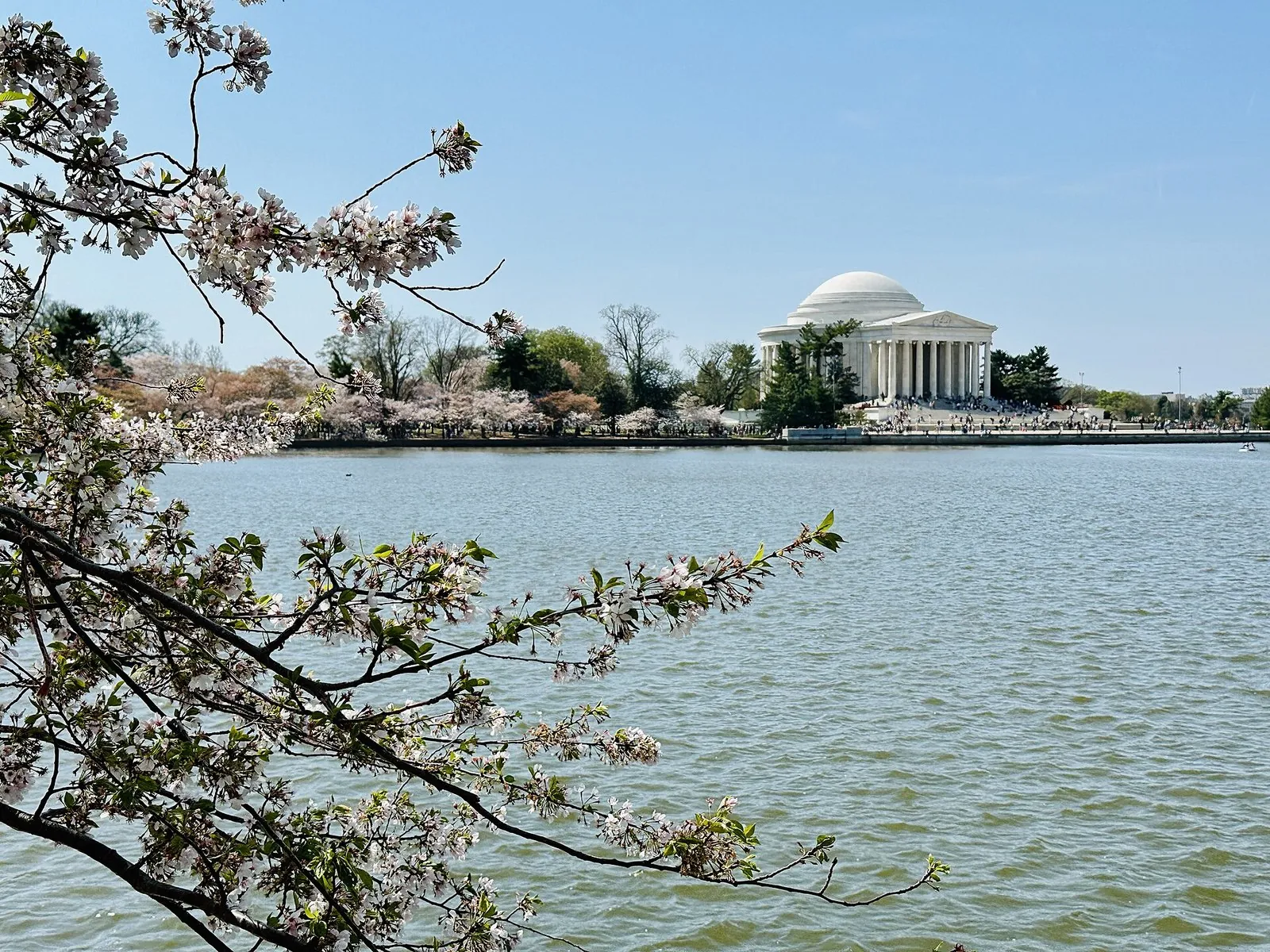
Nobody knows when the DC cherry blossoms will peak, not even the National Park Service, until about ten days before it happens. That’s the whole planning problem in one sentence. Peak bloom, the day 70 percent of the Yoshino cherries around the Tidal Basin are open, has come as early as March 15 and as late as April 18. In 2026 it arrived on March 26, three days before the Park Service’s forecast window even opened. So the smart trip isn’t built around a date. It’s built around a window, a booking you can change, and a plan for where to go when half the region has the same idea you do.
Quick answer: Peak bloom usually lands between the last week of March and the first week of April; over the past ten years it has averaged about March 26. The 2027 National Cherry Blossom Festival runs March 20 to April 11, with the parade on Saturday, April 10. The Park Service issues its forecast in late February or early March, so book flexibly, then see the Tidal Basin at sunrise on a weekday.
Last updated September 24, 2026. Festival dates, bloom history and park details were checked that day against the National Park Service’s and the National Cherry Blossom Festival’s own websites. The 2027 peak bloom date has not been forecast yet.
- 2027 festival: March 20 to April 11, 2027, announced by the festival.
- 2027 peak bloom: not forecast yet. Expect the Park Service’s first prediction in late February or early March 2027.
- 2026 peak bloom: March 26, 2026.
- The Tidal Basin: the seawall rebuild finished in December 2025, eight months early, with a wider walkway and new trees.
- Cost: seeing the trees is free, 24 hours a day.
On this page: At a glance | When they peak | Bloom history | Bloom stages | 2027 festival | Where to see them | Walking the loop | Getting there | Beating the crowds | At night | From the water | A blossom day | Photos | What’s changed | History | Planning a trip | What to skip | FAQ
The 2027 cherry blossom season at a glance
| What | When or how (as of September 2026) |
|---|---|
| National Cherry Blossom Festival | Saturday, March 20 to Sunday, April 11, 2027 |
| Opening ceremony | Saturday, March 20, 5pm to 6:30pm |
| Blossom Kite Festival | Saturday, March 27, 10am to 4pm |
| Petalpalooza at Navy Yard | Saturday, April 3, 1pm to 9pm |
| Parade | Saturday, April 10, 11am to 1pm |
| Peak bloom 2027 | Not forecast yet; historically the last week of March to the first week of April |
| Park Service forecast | Late February or early March 2027 |
| Cost | Free to see the trees, open 24 hours |
| Nearest Metro | Smithsonian (Blue, Orange, Silver lines), about a 10-minute walk to the Tidal Basin |
| Time needed | 1.5 to 2 hours to walk the Tidal Basin loop with stops |
When do the DC cherry blossoms peak?
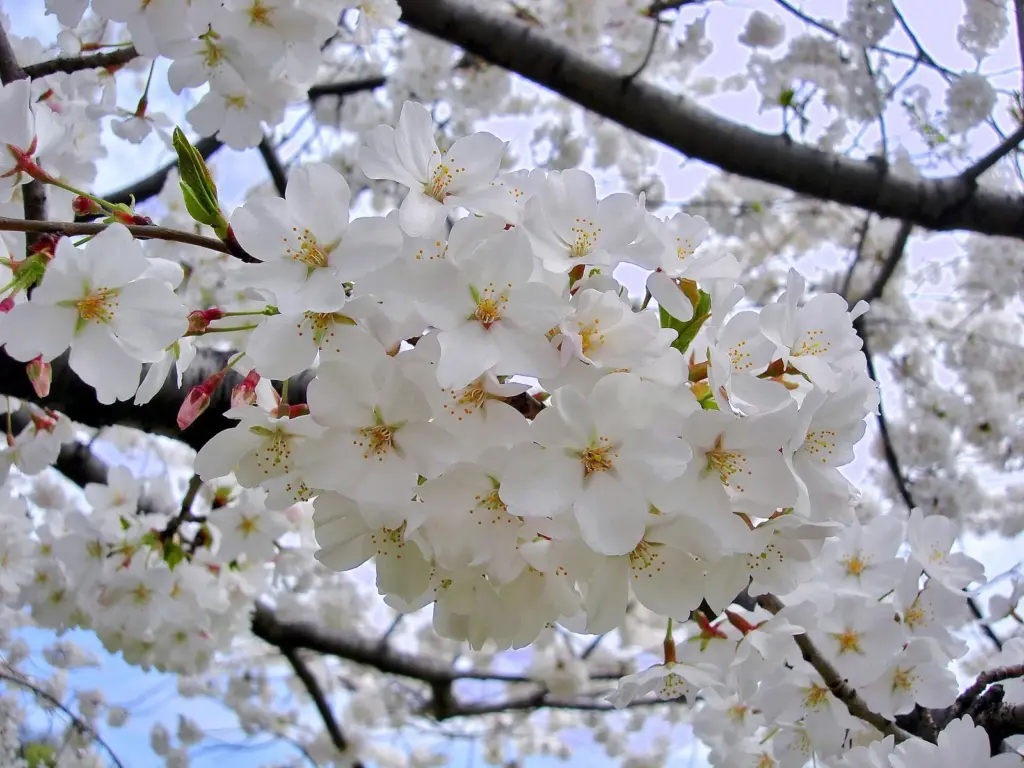
The Park Service defines peak bloom as the day when 70 percent of the Yoshino cherry blossoms around the Tidal Basin are open. The Yoshinos are the white-to-pale-pink trees that make the famous views, and the date moves every year with the weather. A warm February pulls it early. A cold snap in March holds it back. In 2017 a late frost killed a large share of the blossoms just before they opened, which is why that year’s pictures look thin.
The recorded range runs from March 15, in 1990, to April 18, in 1958, and the most likely window is the last week of March through the first week of April. The Park Service says forecasting peak bloom is almost impossible more than ten days out, and it usually publishes its first prediction in late February or early March. Even then, the forecast is a range, and it moves. In 2026 the Park Service predicted March 29 to April 1, and peak arrived on March 26.
Here’s what that means for you. Any website quoting a 2027 peak bloom date in the fall of 2026 is guessing. The festival dates are fixed, and they’re chosen to cover the likely bloom, so any trip that falls within them has a fair chance. The best odds, based on recent years, come from aiming at the last ten days of March and the first few days of April and keeping your plans loose enough to shift.
Peak bloom dates by year, 2004 to 2026
These are the Park Service’s recorded peak bloom dates for the Tidal Basin Yoshinos. They’re the best tool you have for planning, because they show both the usual window and how far a single year can stray from it.
| Year | Peak bloom | Year | Peak bloom |
|---|---|---|---|
| 2026 | March 26 | 2014 | April 10 |
| 2025 | March 28 | 2013 | April 9 |
| 2024 | March 17 | 2012 | March 20 |
| 2023 | March 23 | 2011 | March 29 |
| 2022 | March 21 | 2010 | March 31 |
| 2021 | March 28 | 2009 | April 1 |
| 2020 | March 20 | 2008 | March 26 |
| 2019 | April 1 | 2007 | April 1 |
| 2018 | April 5 | 2006 | March 30 |
| 2017 | March 25 (late frost) | 2005 | April 9 |
| 2016 | March 25 | 2004 | March 31 |
| 2015 | April 10 |
Two patterns stand out when you run the numbers yourself. First, the blossoms have been coming earlier. Over the ten years from 2017 to 2026, peak bloom averaged about March 26, and eight of the ten peaks came in March. Over the 13 years from 2004 to 2016, the average was about April 1, and six of the 13 came in April. Second, the spread is wide in any single year: 2024 peaked on March 17 and 2018 on April 5, almost three weeks apart. That’s why a trip planned in the fall should cover a range of dates rather than one weekend.
The bloom stages, and what each one tells you
From late February the Park Service posts updates on its Bloom Watch page, tracking the Yoshinos through six stages. Knowing them turns a vague forecast into something you can plan around.
- Green buds: the buds show green. Peak is still weeks away.
- Florets visible: tiny flower clusters appear inside the buds.
- Extension of florets: the clusters push out from the buds.
- Peduncle elongation: the flower stems lengthen. Peak is getting close.
- Puffy white: the petals show as white puffs. This is your signal to go.
- Peak bloom: 70 percent of the blossoms are open.
In 2026 the trees reached green buds on March 11, florets visible on March 13, extension of florets on March 16, peduncle elongation on March 21, puffy white on March 22 and peak on March 26. That’s about two weeks from green buds to peak, and four days from puffy white to peak. One year isn’t a rule, but it gives you a feel for the pace once things start moving.
Peak itself lasts only several days, and the Park Service notes that the length depends on the weather. Wind and rain strip the petals fast; a cool, calm week can keep the trees looking good for longer. The days just before peak, when the trees are mostly open but still full, are often just as good as peak day, and the falling petals afterward have their own appeal.
The 2027 National Cherry Blossom Festival
The festival spreads over four weekends to cover the likely bloom, and most of its events are free. The festival’s website listed these 2027 dates in September 2026:
| Event | Date and time | What it is |
|---|---|---|
| Opening Ceremony | Sat, March 20, 5pm to 6:30pm | Performances marking the festival’s start |
| BloomFest at the Tidal Basin | Daily, March 20 to April 11 | Festival presence around the Tidal Basin |
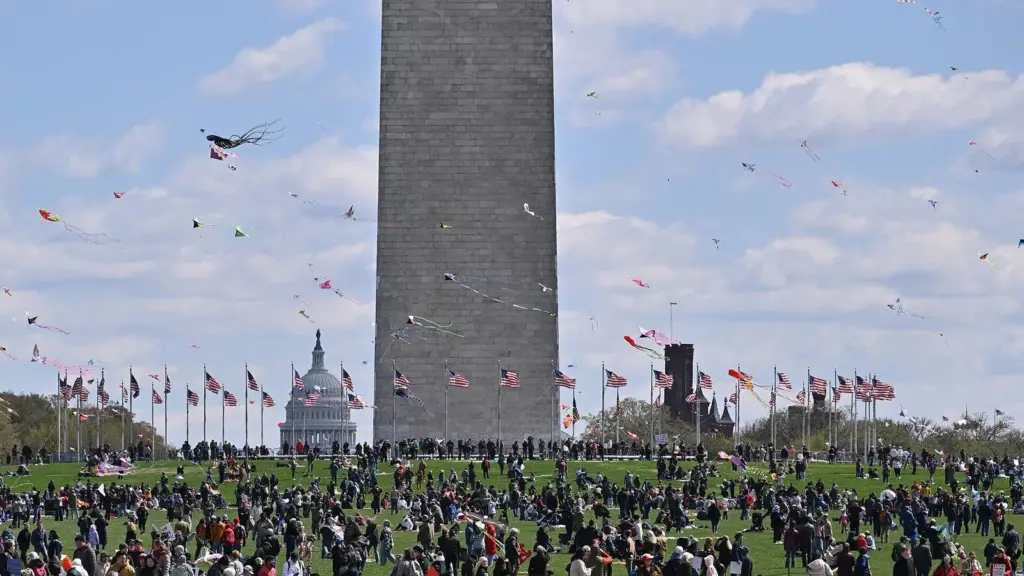
| Blossom Kite Festival | Sat, March 27, 10am to 4pm | Kite flying and competitions by the Washington Monument |
| Sakura Taiko Fest | Sat, March 27, noon to 6pm | Japanese taiko drumming |
| Petalpalooza at Navy Yard | Sat, April 3, 1pm to 9pm | Street party with live music and fireworks near the Anacostia |
| Oxon Run Pinknic and Kite Fly | Sun, April 4, noon to 3pm | Picnic and kites in Oxon Run Park, Southeast DC |
| National Cherry Blossom Festival Parade | Sat, April 10, 11am to 1pm | Floats, bands and giant balloons downtown |
The parade is the festival’s biggest single event, with marching bands, floats and giant helium balloons along Constitution Avenue NW. It lands on April 10, which in most recent years would have been after peak bloom, so don’t assume the parade and the best blossoms will coincide.
Watching the parade. Standing along the route is free. For a spot at the front, arrive an hour early, and bring layers, because you’ll be standing still in whatever April decides to do. Streets downtown close for the parade that morning, so take the Metro; Federal Triangle and Smithsonian stations are the closest to Constitution Avenue. Some seating along the route has been sold in past years, so check the festival’s site if you’d rather sit.
The Blossom Kite Festival fills the sky over the Washington Monument grounds and is one of the best free family days of the spring. It’s also the event most at the mercy of the weather.
Petalpalooza is the festival’s afternoon-into-evening party, with music, activities and fireworks in the Navy Yard neighborhood by the Anacostia River. Take the Green line to Navy Yard-Ballpark. Yellow line trains now end at Mt Vernon Square, so Navy Yard is served by the Green line only.
Sakura Matsuri, the Japanese Street Festival run by the Japan-America Society of Washington DC, filled Pennsylvania Avenue NW between 3rd and 7th Streets on April 11 and 12, 2026. Check sakuramatsuri.org for its 2027 date.
For the rest of the city’s spring calendar, from sports openers to embassy open houses, see our guide to events in Washington DC.
Where to see cherry blossoms in DC
The Tidal Basin gets the crowds, but it isn’t the only place to see the trees, and in a busy year it isn’t always the best. Here are the spots worth your time, in order.
1. The Tidal Basin
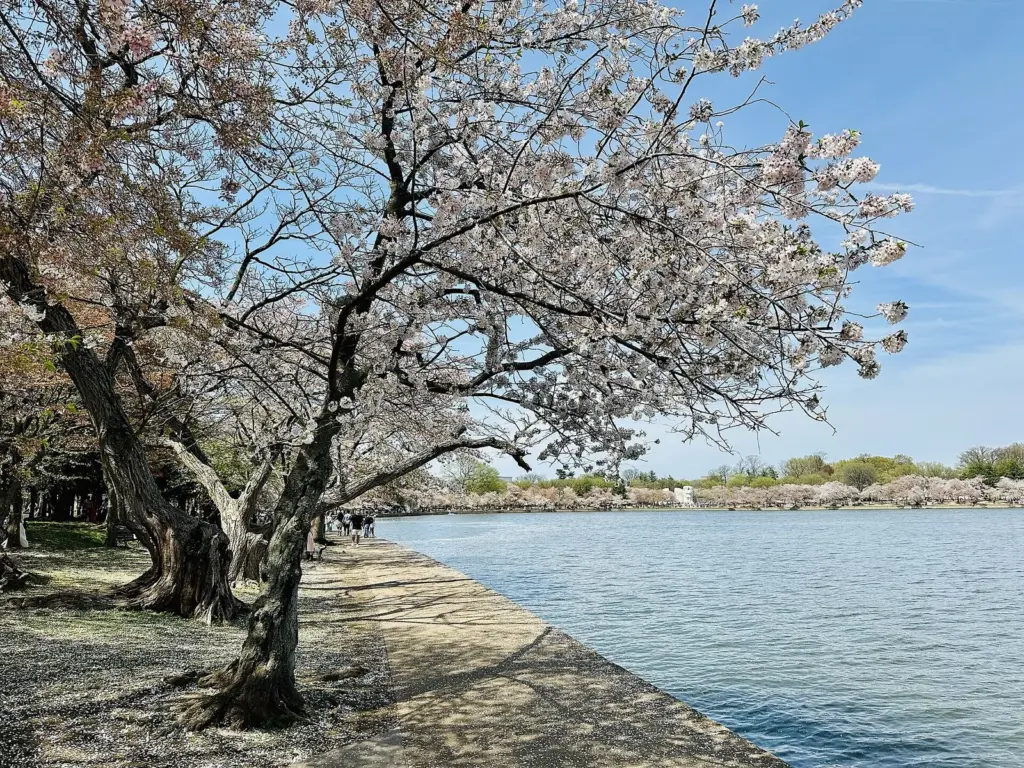
Free, open 24 hours. The loop around the Tidal Basin, about 2 miles, is lined with Yoshino cherries and passes the Jefferson Memorial, the Franklin Delano Roosevelt Memorial and the Martin Luther King Jr. Memorial. It’s the classic view for a reason: the white trees, the water and the Jefferson’s dome in one frame. The two first trees, planted in 1912, still stand near the John Paul Jones statue at the foot of 17th Street. The rebuilt seawall on the south side, finished in December 2025, gives you a wider walkway that no longer floods at high tide.
Plan it: open 24 hours; free. Metro: Smithsonian (Blue, Orange, Silver lines), about a 10-minute walk. Allow 1.5 to 2 hours for the loop with stops. Best time: sunrise on a weekday. Best for: first-timers, photographers.
2. The Washington Monument grounds
Free, open 24 hours. Many of the 3,800 trees Japan gave in 1965 were planted around the Washington Monument, and the slopes below it make a looser, less crowded alternative to the Tidal Basin path. You also get the monument and the blossoms together, which the Tidal Basin can’t give you from most angles.
Plan it: open 24 hours; free. Metro: Smithsonian, about a 5-minute walk. Allow 30 minutes to an hour. Best for: families, picnics, kite festival day.
3. East Potomac Park and Hains Point
Free; the late bloomers. The long peninsula south of the Tidal Basin is lined with Kwanzan cherries, with fluffy double pink blossoms that open about two weeks after the Yoshinos. If you arrive after peak, this is where to go. It’s also far quieter, since it’s a longer walk from the Metro, and you can loop it by bike along Ohio Drive, past the golf course in the middle of the park.
Plan it: open 24 hours; free. No nearby Metro; walk about 20 to 25 minutes from Smithsonian or L’Enfant Plaza, or ride Capital Bikeshare. Roadside parking along Ohio Drive fills early in bloom season. Allow 1 to 2 hours. Best for: late visitors, cyclists, quieter photos.
4. U.S. National Arboretum
Free. The Arboretum in Northeast DC grows many kinds of cherries, including varieties that bloom before and after the Yoshinos, spread over far more space than the Tidal Basin. It’s the place to go if you want blossoms without the crush, and the National Bonsai and Penjing Museum is here too.
Plan it: 8am to 5pm daily, last entry 4:30pm, closed December 25 (as of September 2026); free. Enter at 2400 R St NE. Metro: Stadium-Armory (Blue, Orange, Silver lines), then Metrobus C41. Allow 2 hours. Best for: garden lovers, repeat visitors, drivers.
5. Dumbarton Oaks gardens
Paid, timed tickets. The terraced gardens of this Georgetown estate include cherry trees among spring bulbs and flowering shrubs, and entry is capped, so it never feels mobbed. In 2026 the gardens’ season ran from March 1, with timed tickets bought in advance only.
Plan it: in 2026, Tuesday to Sunday 2pm to 6pm, $15, free for children 2 and under, pre-purchased timed tickets only; check the 2027 schedule at doaks.org. 1703 32nd St NW. No nearby Metro; it’s a long walk or a short ride from Dupont Circle. Allow 1.5 hours. Best for: couples, garden lovers.
6. Kenwood, Maryland
Free. A residential neighborhood just over the DC line in Chevy Chase, Maryland, where cherry trees arch over the streets and turn them into tunnels of blossom. It’s a local favorite and increasingly a visitor one. Remember that people live here: park legally, stay off lawns and keep driveways clear.
Plan it: free. No Metro nearby, so go by car or rideshare. Allow 45 minutes to walk the streets. Best for: photographers, locals, anyone with a car.
7. Oxon Run Park
Free. A long stream-valley park in Southeast DC, where the festival holds its Pinknic and Kite Fly on Sunday, April 4, 2027. It’s the neighborhood side of blossom season, and a very different experience from the Mall.
Plan it: free. Metro: Congress Heights or Southern Avenue (Green line), depending on which end of the park you’re heading for. Allow 1 hour, or the afternoon for the Pinknic. Best for: families, repeat visitors.
How to walk the Tidal Basin loop
The loop is about 2 miles, flat and paved, and it takes about an hour at a steady pace. At peak, with stops for photos and the memorials, plan on two. A good way to do it is clockwise from the paddle boat dock at the northeast corner, on Maine Avenue near 15th Street SW, which is the closest point to Smithsonian station.
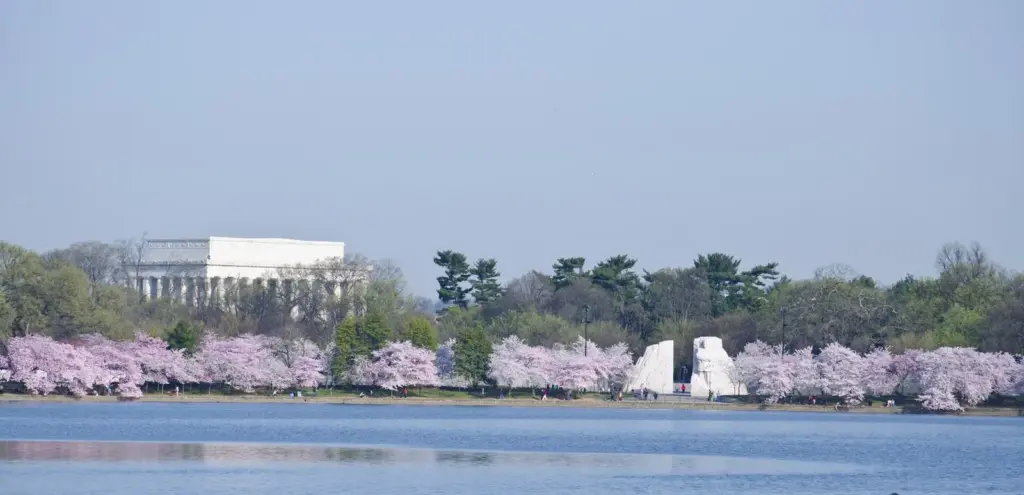
Head south toward the Jefferson Memorial. This side has some of the densest trees and the classic views of the memorial across the water, so it’s also the most crowded; at sunrise it’s the place to be. Climb the Jefferson’s steps for the view back north to the Washington Monument and the White House, which sit on the same axis. Continue west across the Inlet Bridge to the Franklin Delano Roosevelt Memorial, whose four open-air rooms, one for each of his terms, give you a quiet break from the crowd. Then walk north to the Martin Luther King Jr. Memorial, where King’s figure in the Stone of Hope looks out across the water toward the Jefferson.
The last stretch runs east along Independence Avenue, past the John Paul Jones statue at the foot of 17th Street and the two original trees planted in 1912. It’s usually the least crowded part of the loop. Allow extra time at the Jefferson and the FDR if you want to read the inscriptions properly, because both reward it.
The loop is flat throughout, and the rebuilt walkway on the south side is wider and more accessible than the old one, so strollers and wheelchairs manage well. The obstacle at peak is people, not terrain: some of the older stretches are narrow, and on a peak weekend afternoon they barely move. For anyone using a wheelchair or pushing a stroller, sunrise or evening is far easier than midday.
Getting to the Tidal Basin
Metro. Smithsonian station (Blue, Orange, Silver lines) is the closest, about a 10-minute walk via Independence Avenue, and at peak it’s also the most crowded; on busy weekends, expect lines at the escalators. L’Enfant Plaza, which adds the Green and Yellow lines, and Federal Triangle are each a few minutes farther and usually calmer. Rail fares were $2.25 to $6.75 on weekdays before 9:30pm and $2.25 to $2.50 at other times as of September 2026, and you can tap a contactless card or phone at the gates.
Bus and bike. The DC Circulator’s National Mall route, which many older guides recommend, stopped running at the end of 2024, and nothing has replaced it on the Mall. Capital Bikeshare is the better option for linking the Tidal Basin with the Washington Monument grounds and East Potomac Park, but docks near the basin empty and fill fast at peak, so be ready to walk a block or two.
Car and rideshare. Parking near the Tidal Basin is minimal, and at peak the roads around it slow to a crawl. If you must drive, park farther out and walk, or aim for East Potomac Park, where there’s roadside parking along Ohio Drive that fills later in the day. Rideshare drop-offs work best a few blocks from the basin, on the Independence Avenue side, rather than at the memorials themselves.
How to beat the cherry blossom crowds
At peak on a weekend, the Tidal Basin path is shoulder to shoulder from mid-morning to dusk. You can still have a good visit if you work around the crowd rather than through it.
- Go at sunrise. It’s the single best move. The light is soft, the path is walkable and the photos are better. On a weekday at dawn you may have long stretches nearly to yourself.
- Go on a weekday. Tuesday to Thursday mornings are far calmer than any weekend.
- Don’t drive. Parking near the Tidal Basin is minimal and traffic around the Mall backs up badly at peak. Take the Metro or ride a bike.
- Use a different station. Smithsonian is the closest and the most crowded. Walking from Federal Triangle or L’Enfant Plaza adds a few minutes and often saves more than that.
- Ride a bike. Capital Bikeshare charged a $1 unlock plus 15 cents a minute on a classic bike, or $10 for a day pass, as of September 2026. It’s the fastest way to link the Tidal Basin with East Potomac Park.
- Switch locations. If the Tidal Basin is packed, walk to the Washington Monument grounds or down to East Potomac Park, or skip the Mall entirely for the Arboretum.
- Think about evening. The crowds thin after sunset, and the memorials are lit at night, so a walk at dusk works well.
Seeing the cherry blossoms at night
The Tidal Basin never closes, and after dark it’s a different place. The Jefferson Memorial is lit, the Washington Monument glows across the water, and the blossoms pick up the light from the path lamps. The crowds drop sharply after sunset, even at peak, and Park Service rangers are on duty at the memorials until 10pm. Bring a jacket, since late March evenings are often chilly by the water, and give yourself time to walk slowly. For many visitors the night walk ends up being the memory that lasts.
Seeing the blossoms from the water
The paddle boats on the Tidal Basin give you the view the path can’t: the whole ring of trees from the middle of the water. They’re run by Adventures Unbound, and in September 2026 a pedal boat cost $38 on weekdays and $40 on weekends, with Tidal Basin hours of 10am to 7pm on weekdays and 9am to 7pm on weekends. Check Adventures Unbound for the spring 2027 schedule and prices. Lines at the boathouse get long when the trees peak, so go early.
Several sightseeing cruise operators also run blossom-season trips on the Potomac from the Wharf, Georgetown and Old Town Alexandria. The boats can’t enter the Tidal Basin, so what you see from the river is the trees along the Potomac shoreline and East Potomac Park, not the classic Tidal Basin view. They’re a pleasant add-on rather than a substitute for walking the loop.
A cherry blossom day that works
A day built around the crowds rather than against them looks like this.
Sunrise, around 7am in late March. Walk the Tidal Basin loop while it’s quiet. Start at the paddle boat dock and go clockwise so you reach the Jefferson Memorial with the light still low.
Mid-morning. Breakfast somewhere off the Mall, then head indoors as the path fills. The Smithsonian museums open at 10am, and Natural History and American History are both about a 15-minute walk from the Tidal Basin.
Afternoon. Pick up a Capital Bikeshare bike and ride out to East Potomac Park and Hains Point, where the trees are quieter and, later in the season, the Kwanzans are in flower. Or walk the Washington Monument grounds and eat on the grass.
Evening. Dinner at the Wharf, a 15- to 20-minute walk southeast of the Tidal Basin, then back to the lit memorials for a last look. If your day happens to be April 3, 2027, swap in Petalpalooza at Navy Yard, which runs until 9pm.
With a second day, go farther afield: the National Arboretum in the morning, Dumbarton Oaks’ gardens in the afternoon, or Kenwood if you have a car. If it rains, go to the Tidal Basin anyway at dawn. Wet blossoms photograph beautifully, the crowds vanish, and the museums are there for the rest of the day.
Photographing the DC cherry blossoms
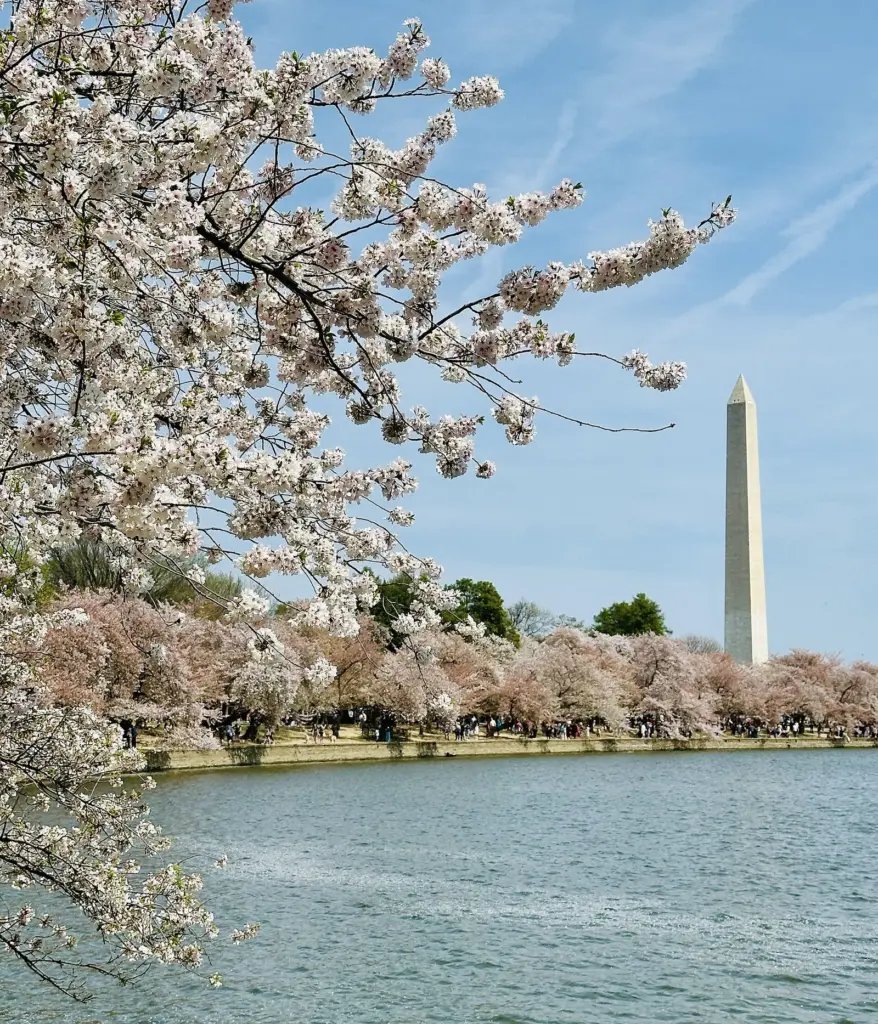
The Jefferson Memorial sits on the south side of the Tidal Basin, facing north, so the classic shot over the water is from the north bank, near Independence Avenue. Sunrise gives you the best light and the fewest people in frame. For the Washington Monument with blossoms, work from the slopes of the Monument grounds or the northwest side of the Tidal Basin.
A few rules and courtesies. Don’t pick blossoms, break branches or climb the trees, which the Park Service asks all visitors to avoid, and which damages trees that are already under stress. Drones are banned over DC. Tripods on the narrow path at peak will make you enemies, so shoot handheld when it’s busy. And give the old trees space: many of their roots sit close to the surface.
What’s changed at the Tidal Basin
If you saw the blossoms before 2024, the Tidal Basin will look a little different. Parts of the original seawall, built in the late 1800s and early 1900s, had sunk more than five feet, and the basin flooded the walkway at high tide every day, drowning tree roots and killing cherry trees. The Park Service’s $113 million rebuild of the Tidal Basin and West Potomac Park seawalls finished in December 2025, eight months ahead of schedule and under budget.
The work came at a cost to the trees. About 306 trees were removed, including the much-photographed stunted cherry nicknamed Stumpy, which became a minor celebrity before it was taken out in 2024. The Park Service planned to plant 426 new trees, 269 of them cherries, in spring 2026. Young trees take years to fill out, so expect some thinner stretches along the rebuilt section for a few seasons. The walkway itself is wider and more accessible, and it no longer floods.
If you’ve read that the Tidal Basin is a construction zone, that information is out of date. The memorials around the basin are part of our guide to Washington DC monuments, which covers each one in more depth.
A short history of the DC cherry trees
The trees were a gift of friendship from Japan, and they almost didn’t happen. The travel writer Eliza Scidmore lobbied for years to plant Japanese cherries along the Potomac, and the idea finally took off with the support of First Lady Helen Taft. A first shipment of 2,000 trees from Tokyo arrived in 1910 infested with insects and disease, and it was burned. Tokyo tried again, and in 1912 sent 3,020 healthy trees.
On March 27, 1912, Helen Taft and Viscountess Chinda, wife of the Japanese ambassador, planted the first two on the north bank of the Tidal Basin. Those two trees still stand near the John Paul Jones statue. In 1965 Japan gave another 3,800 trees, many of them planted on the Washington Monument grounds. The festival grew from a small celebration in the 1930s into the multi-week event it is now, and the trees have become one of the defining images of Washington.
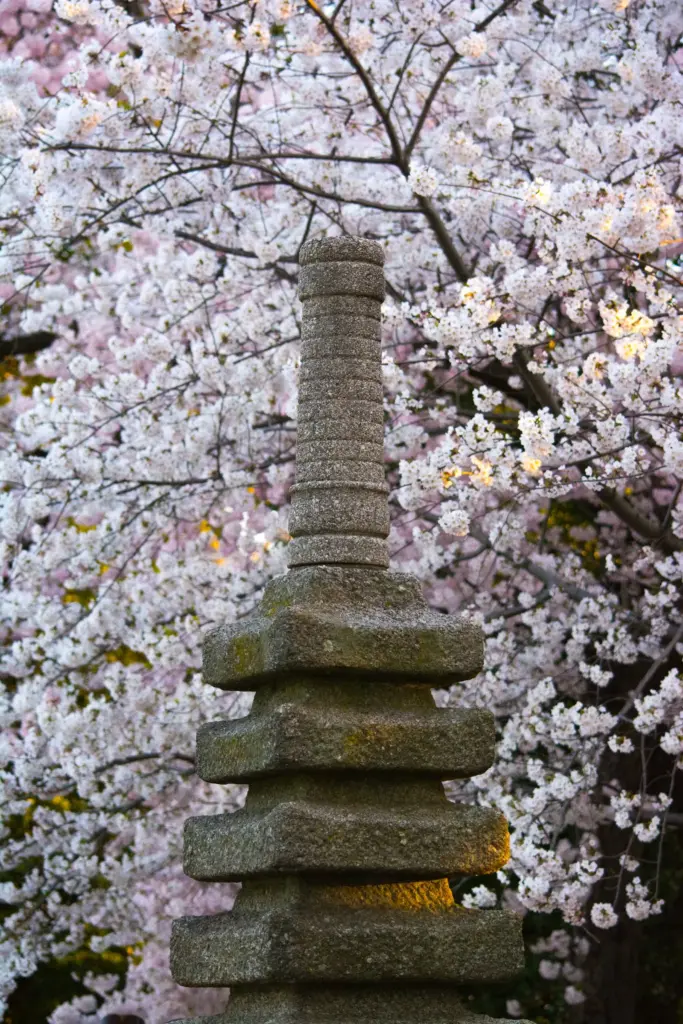
Two other Japanese gifts stand among the trees. A stone lantern carved in 1651 was presented to the city in 1954, and a stone pagoda from the city of Yokohama followed a few years later. Both are easy to walk past without noticing, so look for them as you circle the basin.
The trees are mostly Yoshino, with single white blossoms, around the Tidal Basin, and Kwanzan, with double pink blossoms, in East Potomac Park. That split is why the season has two acts: the Yoshinos first, the Kwanzans roughly two weeks later.
Planning a cherry blossom trip: dates, hotels and backup plans
Choosing dates. If you have to book months ahead, aim for the last ten days of March and the first few days of April, and plan at least three nights so one of them is likely to catch good trees. If you can wait, the Park Service forecast in late February or early March narrows things considerably, and the Bloom Watch stages sharpen it further. For how spring compares with the rest of the year, see our guide to the best time to visit Washington DC.
Booking hotels. Blossom season is one of the busiest and priciest times of year for DC hotels, and rooms near the Mall go early. Book a refundable rate as soon as you know your window, then adjust once the forecast comes out. A hotel near a Metro station matters more than one near the Tidal Basin itself, which has no hotels right on it anyway.
Where to stay. The Southwest Waterfront around the Wharf is the only neighborhood where you can walk to the Tidal Basin at dawn in 15 or 20 minutes. Penn Quarter and downtown put you a short Metro ride from Smithsonian station, and Foggy Bottom is a 20-minute walk from the MLK and Lincoln side of the basin. Across the river, Rosslyn and Crystal City are a few Metro stops away and often cost less during peak weeks. Wherever you stay, choose a hotel within a few minutes’ walk of a Metro station; that matters far more in blossom season than a view.
Weather. Late March in DC can be anything from warm and sunny to cold, wet and windy. Pack layers and a rain jacket, and wear shoes you can walk 5 miles in. A rainy morning thins the crowds nicely, and blossoms photograph well under gray skies.
If you miss peak. Head to East Potomac Park for the Kwanzans, which open about two weeks after the Yoshinos, or to the National Arboretum, where different varieties stretch the season. If you’re early, the Washington Monument grounds and the Tidal Basin often have scattered early trees, and the saucer magnolias that flower around the Mall in early spring fill the gap.
Food and facilities. Food options right at the Tidal Basin are limited, so carry water and snacks, especially at sunrise. For a proper meal, the Wharf is a 15- to 20-minute walk southeast, and L’Enfant Plaza and the Smithsonian museum cafes are close too. Expect lines at every restroom near the memorials on peak weekends.
Budget-friendly. The trees are free, the kite festival and the parade route are free to watch, and the Tidal Basin loop is a free walk. The main costs are hotels and, if you want them, boats and cruises.
Cherry blossom season with kids
Blossom season is easy with children if you choose the right pieces. The Blossom Kite Festival on March 27, 2027 is the best single family day, with a sky full of kites over the Washington Monument grounds; bring your own kite or just watch. Petalpalooza on April 3 is an all-ages party, and the Oxon Run Pinknic and Kite Fly on April 4 is smaller and more relaxed. The paddle boats are a hit with most kids, if you can face the line.
On the Tidal Basin itself, go early, keep small children close on the narrow stretches near the water’s edge, and plan a stop at the Jefferson Memorial, where the steps and the giant statue hold their attention. Bring snacks and water, because options right at the basin are limited. A loop plus the Washington Monument grounds is about as much as young legs will manage before lunch.
What to skip during cherry blossom season
Skip any “2027 peak bloom forecast” you see before late February. The Park Service itself says forecasting is almost impossible more than ten days out.
Skip driving to the Tidal Basin. Parking is scarce and traffic stalls at peak. The Metro or a bike is faster.
Skip the Tidal Basin at noon on a peak Saturday unless you enjoy crowds. Go at sunrise, or spend the middle of the day at East Potomac Park or the Arboretum.
Skip tours that simply walk the Tidal Basin loop. The path is easy to follow on your own, and the memorials have Park Service signs and rangers. Paid tours earn their price when they add transport, a boat or real expertise.
Skip planning your whole trip around the parade. It’s fun, but on April 10 it’s likely to fall after the Yoshinos’ peak.
DC Cherry Blossoms FAQ
When is peak bloom for the DC cherry blossoms in 2027?
Nobody knows yet. The National Park Service usually issues its forecast in late February or early March, and says forecasting more than ten days out is almost impossible. Historically, peak bloom falls between the last week of March and the first week of April. In 2026 it came on March 26.
When is the 2027 National Cherry Blossom Festival?
The 2027 festival runs from Saturday, March 20 to Sunday, April 11. The opening ceremony is on March 20, the Blossom Kite Festival on March 27, Petalpalooza at Navy Yard on April 3, and the National Cherry Blossom Festival Parade on Saturday, April 10, from 11am to 1pm, according to the festival.
Are the cherry blossoms blooming in DC yet?
Not in the fall or winter. DC’s cherry trees bloom once a year, in spring. From late February the National Park Service posts the Yoshino trees’ progress through six stages, from green buds to peak, on its Bloom Watch page. Once the trees reach the puffy white stage, peak is close.
Where is the best place to see cherry blossoms in DC?
The Tidal Basin, with the Jefferson, FDR and Martin Luther King Jr. memorials, is the classic spot, best at sunrise on a weekday. For fewer crowds, try the Washington Monument grounds, East Potomac Park, where Kwanzan trees bloom about two weeks later, or the U.S. National Arboretum.
How long do the DC cherry blossoms last?
Peak bloom, when 70 percent of the Yoshino blossoms are open, typically lasts several days, depending on the weather. Wind and rain shorten it; cool, calm days stretch it out. The trees look good for a few days on either side of peak, and East Potomac Park’s Kwanzan cherries bloom about two weeks later.
Were the DC cherry trees cut down?
Some were. About 306 trees, including the well-known stunted tree nicknamed Stumpy, were removed for the Tidal Basin seawall rebuild, which finished in December 2025. The Park Service planned to plant 426 new trees, 269 of them cherries, in spring 2026. Thousands of trees remain around the basin and the Mall.
Can you pick or press cherry blossoms in DC?
Don’t pick them. The Park Service asks visitors not to pick blossoms, break branches or climb the trees around the Tidal Basin, and damaging park plants breaks federal park rules. If you want to press cherry blossoms, use flowers from your own tree or a florist, not from the trees on the Mall.
What is the best time of day to see the cherry blossoms?
Sunrise. The light is softest, the Tidal Basin path is nearly empty on weekdays, and you can walk the loop before the tour groups arrive around mid-morning. Evening is the second-best choice, when crowds thin and the memorials are lit. Midday on a peak weekend is the most crowded time of all.
Related Washington DC Guides
- Washington DC Monuments and Memorials: the Jefferson, FDR and MLK memorials on the Tidal Basin, and the rest of the Mall.
- Best Time to Visit Washington DC: how blossom season compares with fall and the rest of the year.
- Events in Washington DC: the city’s calendar, spring festivals included.
Sources and How We Checked
We checked the festival dates, bloom history and park details on this page on September 24, 2026 against the official websites below, and compiled the page from them. We don’t claim first-hand visits.
- National Park Service: Bloom Watch and peak bloom history
- National Cherry Blossom Festival
- National Park Service: Tidal Basin seawall completion
- National Cherry Blossom Festival: Petalpalooza
- Sakura Matsuri Japanese Street Festival
- U.S. National Arboretum
We also checked Dumbarton Oaks, Adventures Unbound, Capital Bikeshare and WMATA. The ten-year and 13-year averages are our own calculations from the Park Service’s recorded dates.
Washington DC Tourism Guide is an independent publication. We are not affiliated with Destination DC, the National Park Service, the Smithsonian Institution, the National Cherry Blossom Festival or any attraction listed here, and no one paid to be included.
Photo Credits
- Jefferson Memorial and cherry blossoms, 2026: photo by APK, via Wikimedia Commons (CC BY 4.0)
- Yoshino cherry blossoms: photo by Uberlemur at the English Wikipedia, via Wikimedia Commons (CC BY-SA 3.0)
- Blossom Kite Festival, 2026: photo by G. Edward Johnson, via Wikimedia Commons (CC BY 4.0)
- Tidal Basin seawall walkway, 2026: photo by APK, via Wikimedia Commons (CC BY 4.0)
- Japanese stonework among the cherry trees: photo by Tim Evanson, via Wikimedia Commons (CC BY-SA 2.0)
- Cherry blossoms and the Washington Monument: photo by APK, via Wikimedia Commons (CC BY 4.0)
- Martin Luther King Jr. Memorial across the Tidal Basin: photo by Tim Evanson, via Wikimedia Commons (CC BY-SA 2.0)