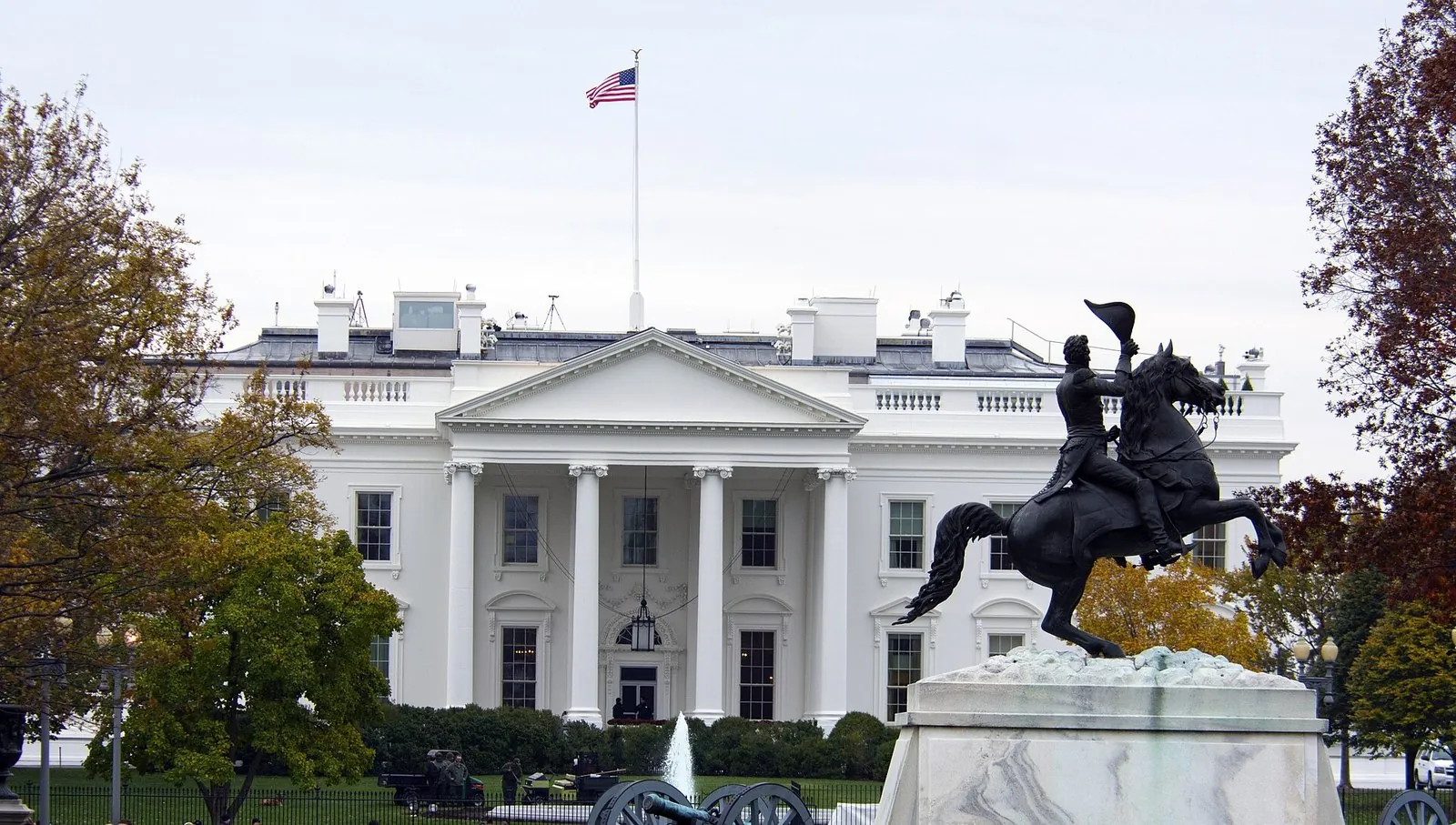
The White House tour is free, self-guided and over in well under an hour. Getting one is the hard part, and it’s mostly paperwork: a request through your member of Congress or your embassy, sent at least three weeks and up to three months before you arrive, a background check, and then a wait to hear whether you got a slot. Plenty of people start too late, or book a paid “White House tour” that never goes inside. This guide walks you through the request step by step, explains what the 2025 East Wing demolition changed about the route, and covers every other government building a visitor can actually get into, from the Capitol to the Supreme Court.
Quick answer: U.S. citizens request White House tours through their member of Congress, and international visitors through their country’s embassy in Washington. The National Park Service says to apply no less than 21 days and up to three months ahead. Tours are free and self-guided, generally Tuesday to Saturday mornings, and can be canceled at short notice. Since December 2, 2025, they follow an updated route that skips the East Wing rooms, including the East Room.
Last updated September 24, 2026. Tour rules, hours and route changes were checked that day against the National Park Service’s, the White House’s and each building’s own websites, plus news reports on the route change.
- How to request: through your U.S. representative or senators (citizens) or your embassy (foreign nationals). The Capitol Switchboard, 202-224-3121, connects you to any congressional office.
- When: at least 21 days and up to three months ahead, per the Park Service. Earlier is better; spaces are limited and first come, first served.
- Tour times: Tuesday to Thursday 7:30 to 11:30 a.m., Friday and Saturday 7:30 a.m. to 1:30 p.m., excluding federal holidays (as of September 2026).
- Cost: free. Anyone charging you for “White House tour tickets” is selling an outside walking tour or a scam.
- What changed: the East Wing was demolished in October 2025 for a new ballroom. Tours resumed on December 2, 2025, without the East Room, China Room, Vermeil Room, Library, East Garden Room, Family Theater and East Colonnade.
On this page: At a glance | How to request a White House tour | On the day | History | What you’ll see | If you can’t get a tour | Every government building you can tour | A Capitol Hill day | A White House morning | Accessibility and kids | Security | What to skip | FAQ
Government buildings pair naturally with the memorials. Our guide to the monuments and memorials on the National Mall covers the rest of a day around the White House.
DC’s Government Buildings at a Glance
Every building in this table is free to enter. Hours and rules are as posted in September 2026; each can change at short notice for security or official business.
| Building | How to get in | Book ahead? | Hours | Time needed |
|---|---|---|---|---|
| White House | Request via Congress or embassy | 21 days to 3 months | Tue-Thu 7:30-11:30 a.m.; Fri-Sat 7:30 a.m.-1:30 p.m. | 30-45 min inside, plus security |
| U.S. Capitol | Free guided tour from the Capitol Visitor Center | Recommended; walk-ups welcome | Arrive by 2:30 p.m. without a booking | 1.5-2 hours with the Visitor Center |
| House and Senate galleries | Passes from your representative and senators, or the Visitor Center for international visitors | Contact your office | When in session; House gallery also weekdays 9-4 when not | 30-60 min |
| Library of Congress | Free timed-entry ticket | Up to 30 days; same-day at 9 a.m. | Tue-Sat 10-5; Thu to 8 | 1-1.5 hours |
| Supreme Court | Walk in through security | No | Mon-Fri 9-3 | 45 min-1 hour |
| National Archives Museum | Walk in, or optional reservation | Optional | Daily 10-5:30 | 1-1.5 hours |
| Bureau of Engraving and Printing | Free ticket | Yes; same-day online from 8 a.m. | Mon-Fri 9-2 | 45 min |
| White House Visitor Center | Walk in | No | Daily 7:30-4 | 30-45 min |
How to Request a White House Tour, Step by Step
The process hasn’t changed in principle for years, but the details trip people up. Here’s the whole thing in order.
Step 1: Pick your dates and count backward
Public tours generally run Tuesday through Saturday, excluding federal holidays: Tuesday to Thursday from 7:30 to 11:30 a.m., and Friday and Saturday from 7:30 a.m. to 1:30 p.m., as of September 2026. The National Park Service asks for requests no less than 21 days ahead and up to three months ahead; the White House’s own site has given a wider window of 7 to 90 days. Plan on the Park Service’s version. Send your request as close to the three-month mark as you can, because tours are allocated first come, first served and spaces are limited. Offer a few alternative dates if the form allows it.
Step 2: U.S. citizens, contact your member of Congress
Your representative and your two senators can all request tours for constituents. Most congressional offices have an online tour request form on their website; if you can’t find it, call the Capitol Switchboard at 202-224-3121 and ask to be put through to the office. You can only go through your own members, based on where you live. It’s worth asking the same office for a Capitol tour and House or Senate gallery passes at the same time, since they handle all three.
Step 3: International visitors, contact your embassy
Foreign nationals request tours through their country’s embassy in Washington. Embassies handle this differently, and some have limited capacity or don’t offer it at all, so contact yours well before the three-month window opens and ask how their process works.
Step 4: Send accurate details for the security check
Every visitor on the request is screened in advance, so the office will ask for personal details for each person. Enter every name and detail exactly as it appears on the ID each adult will carry on the day. A mismatch between your request and your ID can keep you out of the building.
Step 5: Wait for confirmation, and keep a backup plan
Your congressional office or embassy will tell you if your tour is confirmed, often only a week or two ahead. A request isn’t a guarantee, and even confirmed tours can be canceled at short notice for official events or security reasons. The White House Visitors Office runs a 24-hour information line, 202-456-7041, for last-minute updates. Build your day so a cancellation doesn’t wreck it: the White House Visitor Center, Lafayette Square and the Ellipse are all a few minutes away.
Step 6: Read your confirmation carefully
Your confirmation tells you the time and where to report. Since the East Wing demolition, the route and the arrival point have changed from what older guides describe, so rely on the instructions you’re given rather than anything you read online, including this page.
Request routes compared
Who you are decides where you apply. Here’s the short version.
| You are | Apply through | When | Bring on the day |
|---|---|---|---|
| A U.S. citizen | Your representative or either of your senators | At least 21 days and up to 3 months ahead | Government-issued photo ID for each adult, matching the request |
| A foreign national | Your country’s embassy in Washington | Ask your embassy; start before the 3-month window | Passport matching the request |
| A mixed group | Usually the U.S. citizen’s member of Congress; ask the office how it handles foreign guests | As early as allowed | ID for every adult |
| Visiting at Christmas | The same routes; demand peaks in December | Right at the 3-month mark | ID, and patience in the line |
White House tours and Capitol tours are different
People often confuse the two. The White House tour is only available through a congressional office or an embassy, weeks in advance, with a background check. The Capitol tour is run by the Capitol Visitor Center, can be booked online by anyone and takes walk-ups. Your congressional office can help with both, and with gallery passes, so ask for everything in one request.
What to Expect on the Day of Your White House Tour
Arrive early and travel light. Security screening is thorough, and the list of prohibited items is long and strictly enforced. Plan to bring only what you can carry in your pockets: phone, wallet and ID. Leave bags, backpacks, strollers, food and drinks at your hotel, because there’s no storage at the entrance. The current prohibited-items list comes with your confirmation; check it the night before.
Bring ID for every adult. Each adult needs a valid, government-issued photo ID that matches the details submitted with the request. International visitors should bring their passports.
Expect to go at your own pace. The tour is self-guided, with Secret Service officers posted along the route who answer questions and can tell you about the rooms. Most people are through in 30 to 45 minutes, not counting the security line.
Getting there: Metro: McPherson Square or Farragut West (Blue, Orange, Silver lines) or Federal Triangle, each within about a 10-minute walk of the White House grounds. Parking nearby is scarce and roads close without notice, so don’t drive.
The White House in Brief
The house you’ll walk through has been rebuilt and extended more than once. Construction began in 1792, and John Adams became the first president to live there, in 1800. British troops burned it in 1814, and it was rebuilt within a few years. The West Wing, with the president’s offices, was added in 1902, and the Oval Office in 1909. Between 1948 and 1952, President Truman had the interior gutted and rebuilt inside the original walls, which is why many of the rooms you’ll see are period reconstructions rather than original fabric.
The East Wing, where public tours used to begin, dated from 1942. It held the first lady’s offices, the social office and the visitor entrance, and it was demolished in October 2025 to make way for the new ballroom. That’s why the 2026 route is shorter than the one described in older guides, and why the view of the east side of the house has changed.
What You’ll See on the White House Tour in 2026
The tour route passes through the ground floor and the State Floor of the Executive Residence. As of September 2026, the rooms on the listed route are the Entrance Hall, the Cross Hall, the Blue Room, the Red Room, the Green Room and the State Dining Room. The Blue Room, oval and furnished in the French Empire style, is where presidents receive guests and where the official White House Christmas tree usually stands. The State Dining Room, which seats well over 100 for state dinners, has a portrait of Abraham Lincoln over the fireplace.
What’s no longer on the route. Public tours used to begin in the East Wing and pass through the East Colonnade, the East Garden Room, the Library, the Vermeil Room, the China Room and, most famously, the East Room, the largest room in the house. After the East Wing was demolished in October 2025 to build a new ballroom, tour bookings, which had been suspended since late August, stayed paused until December 2, 2025, when public tours resumed on an updated route that skips all of those spaces, along with the Center Hall and the Family Theater. The ballroom is reported to be planned for completion in 2028, so expect the shorter route to continue for the life of this guide.
The honest verdict. The shorter route makes the tour quicker, and the East Room was many visitors’ favorite. It’s still worth doing if you can get it: few countries let the public walk through the head of state’s working residence for free. But it’s no longer worth rearranging a whole trip around, and if your request comes through, a morning slot pairs well with the museums on the Mall afterward.
At Christmas. In December, the public tour shows the White House holiday decorations, and requests are made the same way. Demand is at its peak, so apply the moment your three-month window opens.
If You Can’t Get a White House Tour
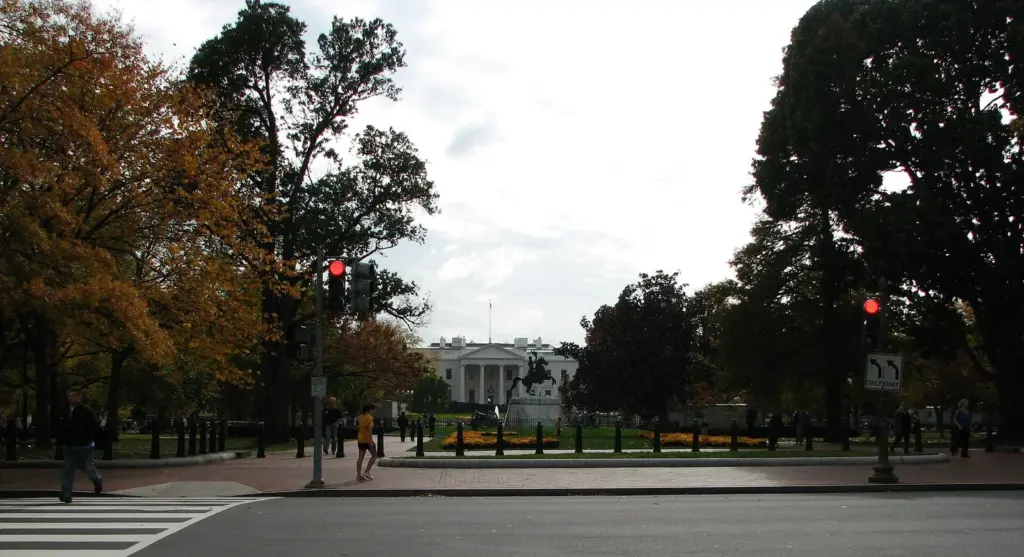
Most visitors don’t get inside, and you can still get a good look at the place.
The White House Visitor Center. Run by the National Park Service at 1450 Pennsylvania Avenue NW, in the Department of Commerce building, it has exhibits on the house’s architecture, first families and daily life, plus rangers who answer questions. It’s open 7:30 a.m. to 4 p.m. daily except January 1, Thanksgiving and December 25, as of September 2026.
The north view from Lafayette Square. The pedestrian stretch of Pennsylvania Avenue and Lafayette Park give you the classic view of the North Portico, framed by the park’s statues, including Andrew Jackson on horseback at its center. It’s the best spot for photos, and the park is ringed by historic buildings, including St. John’s Church and Decatur House. Access is sometimes restricted for security or demonstrations.
The south view from the Ellipse. From the Ellipse, south of the White House, you see the South Portico and the South Lawn, with construction on the east side visible as the ballroom goes up. In December, the Ellipse holds the National Christmas Tree.
The online tour. The White House Historical Association publishes a virtual tour of the house, including rooms that are off the public route. It’s a good way to see the East Room while the ballroom is built.
Every Government Building You Can Tour, Ranked
Ranked by how rewarding they are for a typical visitor, balanced against how hard they are to get into.
1. The White House
Free; request 21 days to 3 months ahead. The one everyone wants, and the hardest to get. Everything you need is in the sections above: request through Congress or your embassy, travel light, bring ID and expect a shorter route than before the East Wing demolition. If it comes through, it’s a genuinely rare experience. If not, the Visitor Center and the views from Lafayette Square and the Ellipse fill the gap.
Plan it: Tuesday to Thursday 7:30 to 11:30 a.m., Friday and Saturday 7:30 a.m. to 1:30 p.m. (as of September 2026). Free. Metro: McPherson Square or Farragut West (Blue, Orange, Silver lines), 10-minute walk. Pockets only; ID for adults. Allow 1.5 hours including security. Best for: anyone who planned ahead.
2. U.S. Capitol
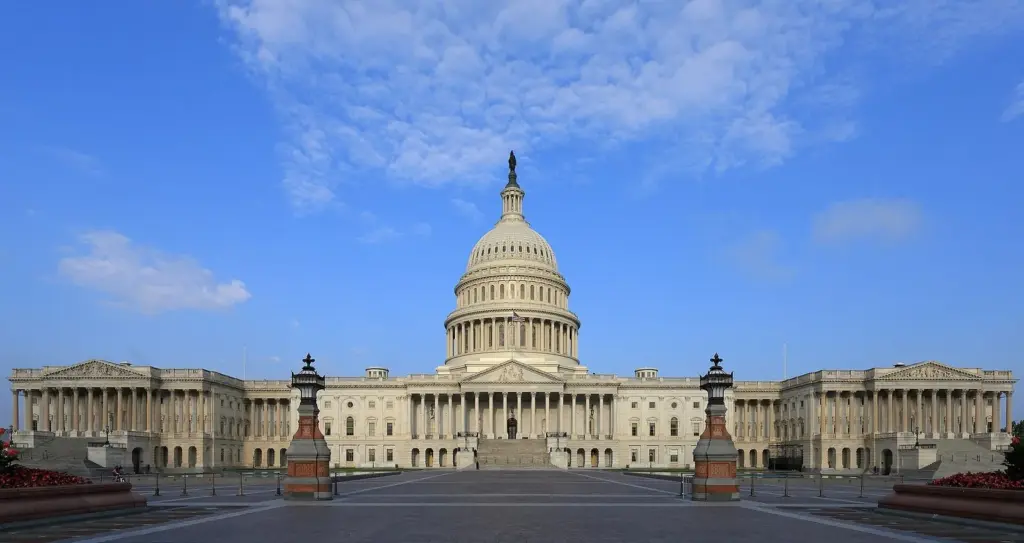
Free guided tours; book ahead or walk up early. For most visitors, this is the best government tour in the city: easy to get, guided by professionals and full of history. Tours start at the Capitol Visitor Center, which sits underground on the Capitol’s east side, and take you through the Crypt, the Rotunda under the dome and National Statuary Hall, the old House chamber, with its statues donated by the states. All tours are guided; you can’t wander on your own.
Book a time on the Visitor Center’s reservation site, or ask your congressional office, which can sometimes arrange a staff-led tour. Walk-ups are welcome and get the next available slot, but the Visitor Center recommends arriving no later than 2:30 p.m. if you don’t have a reservation. The standard tour doesn’t include the House or Senate galleries; those need separate passes, covered below.
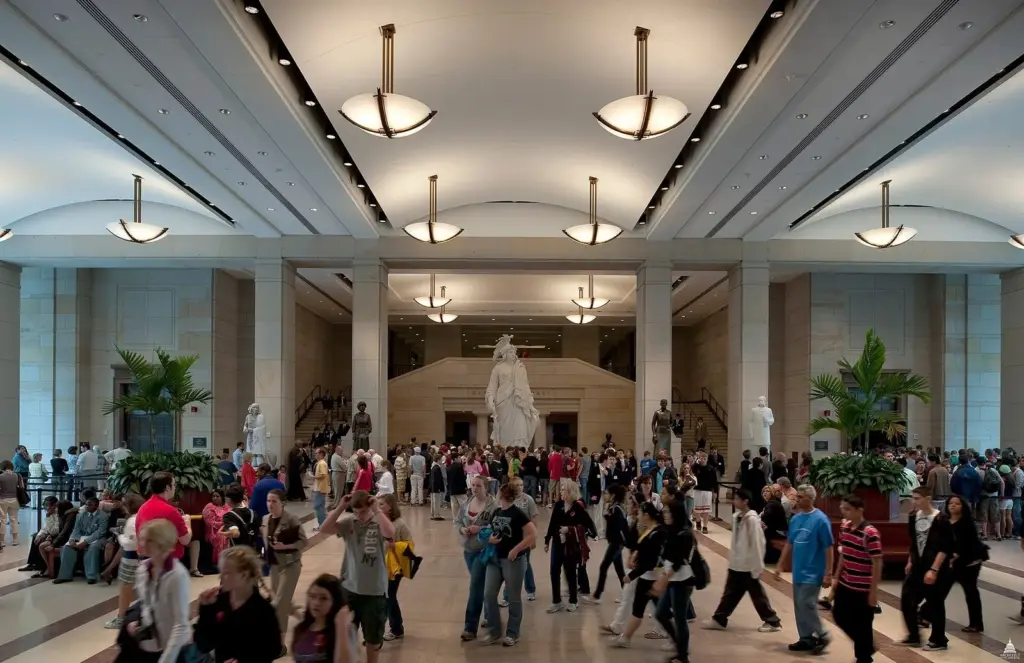
Plan it: Free, guided only. Reserve online or walk up by 2:30 p.m. Enter at the Capitol Visitor Center on the east side. Metro: Capitol South (Blue, Orange, Silver lines) or Union Station (Red line), 10-minute walk. Airport-style security; check the prohibited-items list. Allow 1.5 to 2 hours. Best for: first-timers, families, history buffs.
3. Library of Congress
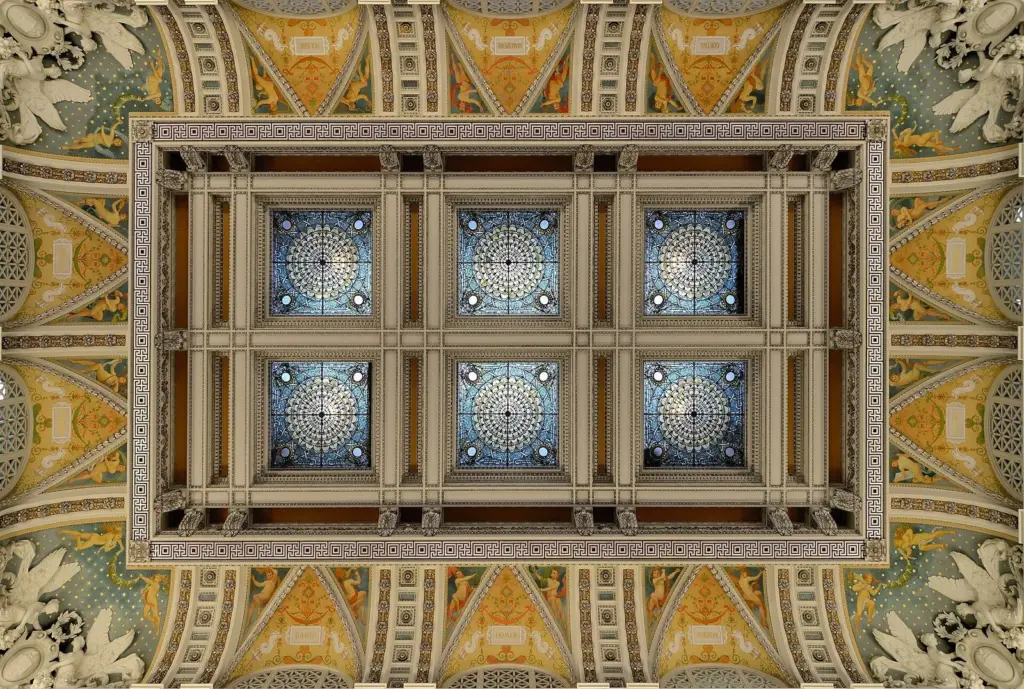
Free timed-entry ticket required. The Thomas Jefferson Building is the most beautiful interior in Washington, and many visitors like it more than the Capitol itself. The Great Hall is a riot of marble, mosaics, murals and gilding, and the overlook onto the domed Main Reading Room is hushed and grand. Exhibitions draw on the world’s largest library, from Thomas Jefferson’s own books to the Treasures Gallery, which opened in June 2024.
Book free timed-entry tickets up to 30 days ahead, or try for same-day tickets, released online at 9 a.m. Eastern. Reservations cover up to 20 people; groups of 21 or more register separately, up to 60 days ahead. It’s across First Street from the Capitol.
Plan it: Tuesday to Saturday 10 a.m. to 5 p.m., last entry 4:30 p.m., with Thursday hours to 8 p.m.; closed Sundays, Mondays and some federal holidays (as of September 2026). Free timed-entry ticket. Metro: Capitol South (Blue, Orange, Silver lines), 5-minute walk. Allow 1 to 1.5 hours. Best for: architecture lovers, book lovers, anyone doing the Capitol.
4. National Archives Museum
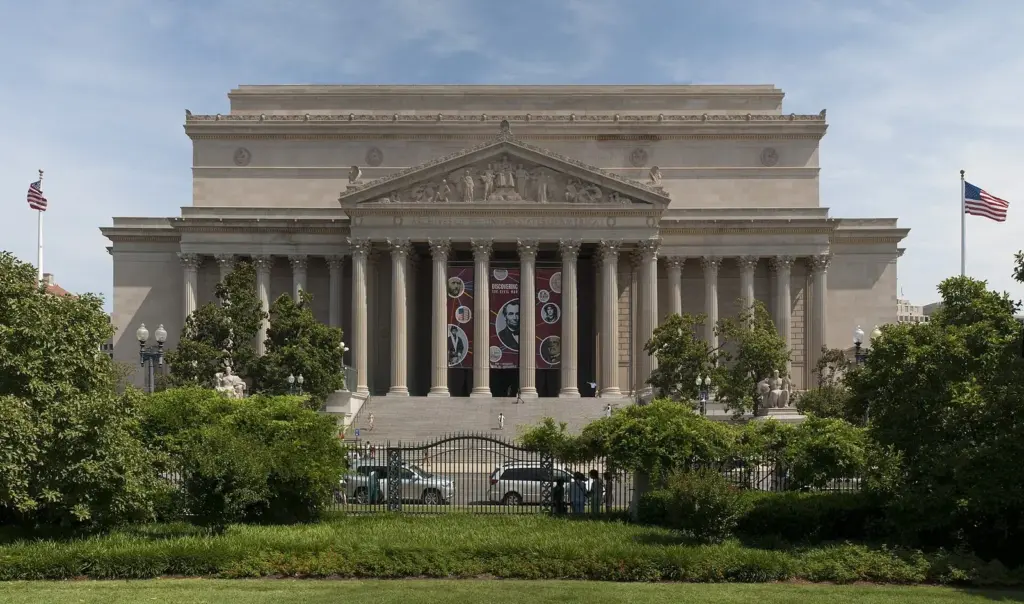
Free; reservations optional. In a dim rotunda on Constitution Avenue, the Declaration of Independence, the Constitution and the Bill of Rights, the documents known as the Charters of Freedom, sit in sealed cases. You’ll shuffle past them in a line with everyone else, and it still gets people. The museum also displays a 1297 copy of Magna Carta, and its exhibition Free and Independent runs from April 25, 2026, to July 5, 2027.
At peak times the walk-in line can take an hour or more. Reservations are optional: free general-admission tickets or $1 timed-entry tickets through the Archives’ ticketing partner get you in faster.
Plan it: Daily 10 a.m. to 5:30 p.m. (as of September 2026). Free; optional reservations. Metro: Archives-Navy Memorial-Penn Quarter (Green, Yellow lines), 2-minute walk. Allow 1 to 1.5 hours. Best for: history buffs, older kids, rainy days.
5. Supreme Court
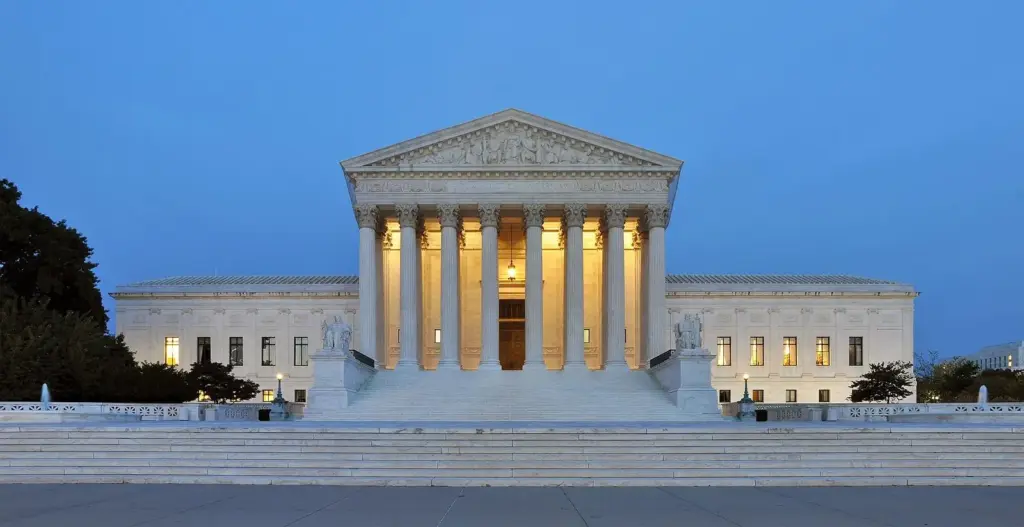
Free; walk in on weekdays. The Supreme Court Building, at 1 First Street NE, is open to the public Monday to Friday from 9 a.m. to 3 p.m., and closed on weekends and all federal holidays, as of September 2026. Inside, you can explore on your own, see exhibitions on the Court’s history and, when the Court isn’t sitting, attend a courtroom lecture about how it works. Court sessions, including the days when opinions are handed down, are also open to the public, with limited seating.
The Court warns that its business can affect public access and visitor programs, so check its daily calendar before you go. There’s a cafe inside, which makes it a handy lunch stop on a Capitol Hill day.
Plan it: Monday to Friday, 9 a.m. to 3 p.m. Free. Metro: Capitol South (Blue, Orange, Silver lines) or Union Station (Red line), 10-minute walk. Security screening. Allow 45 minutes to 1 hour, longer for a session. Best for: civics fans, students, weekday visitors.
6. House and Senate Galleries
Free passes; watch Congress at work. The standard Capitol tour doesn’t include the chambers, but you can sit in the public galleries above them. U.S. citizens get House gallery passes from their representative and Senate passes from their senators. International visitors can get passes for both at the House and Senate Appointment Desks in the Capitol Visitor Center by showing ID. The passes are reusable. When the House isn’t in session, its gallery is still open to visitors on weekdays from 9 a.m. to 4 p.m. Congress usually sits from January to July and September to mid-December, with a long recess in August.
Plan it: Passes from your members of Congress, or the Visitor Center’s appointment desks for international visitors. Free. Metro: Capitol South (Blue, Orange, Silver lines). Stricter rules apply in the galleries, including limits on phones and bags. Allow 30 to 60 minutes. Best for: politics fans, students.
7. Bureau of Engraving and Printing
Free ticket required. Watch sheets of real currency being printed, cut and inspected from a gallery above the production floor at 14th and C Streets SW, a few minutes from the Washington Monument. Free tickets are required year-round, online or by phone at (855) 391-2990, with same-day tickets released online from 8 a.m. The extended summer season ended on September 4, 2026, so tours now run Monday to Friday from 9 a.m. to 2 p.m., and they pause from December 24, 2026, to January 2, 2027, and on federal holidays.
Plan it: Monday to Friday, 9 a.m. to 2 p.m. (as of September 2026). Free ticket. Metro: Smithsonian (Blue, Orange, Silver lines), 5-minute walk. Allow 45 minutes. Best for: families, curious kids, a weekday morning near the Mall.
8. White House Visitor Center
Free, walk in. The consolation prize that turns out to be good. Exhibits cover the building’s history and design, the first families and the staff who run the residence, and rangers are on hand. It’s the best rainy-hour stop near the White House.
Plan it: Daily 7:30 a.m. to 4 p.m., except January 1, Thanksgiving and December 25 (as of September 2026). Free. 1450 Pennsylvania Avenue NW. Metro: Federal Triangle (Blue, Orange, Silver lines), 5-minute walk. Allow 30 to 45 minutes. Best for: anyone without a tour, families.
9. Lafayette Square and President’s Park
Free, open-air. Lafayette Square, north of the White House, and the Ellipse, to its south, together form President’s Park, managed by the National Park Service. Lafayette Park gives the classic North Portico view and holds statues of Jackson and of foreign generals who fought in the Revolution, including the Marquis de Lafayette. The Ellipse gives the South Portico view and hosts the National Christmas Tree in December. Security perimeters shift, so some paths may be fenced off on the day you visit.
Plan it: Open daily; access can be restricted for security. Free. Metro: McPherson Square or Farragut West (Blue, Orange, Silver lines). Allow 20 to 30 minutes. Best for: photos, everyone.
10. The Pentagon
Free; advance reservation required. Tours of the Pentagon, across the river in Arlington, are run by the Pentagon Tours program and must be reserved in advance through its official website, with different rules for U.S. citizens and foreign nationals. Expect strict ID and security requirements, and check the program’s current lead times before you plan around it. The outdoor Pentagon Memorial, honoring the 184 people killed there on September 11, 2001, is open to visitors without a tour.
Plan it: Reservation through the Pentagon Tours program. Free. Metro: Pentagon (Blue, Yellow lines). Allow half a day with travel and security. Best for: military history fans who book well ahead.
How to See Capitol Hill in One Day
The Capitol, the Library of Congress and the Supreme Court sit within a few minutes’ walk of each other, and together they make one of the best days in Washington. Here’s an order that works on a weekday.
Morning: a Capitol tour from the Visitor Center, booked for 9 or 10 a.m. Afterward, if you’ve arranged gallery passes, spend half an hour watching the House or Senate. Midday: the Supreme Court, open until 3 p.m., with lunch in its cafe or at the Capitol Visitor Center’s restaurant. Afternoon: the Library of Congress with a timed ticket, then a walk down the hill past the Capitol Reflecting Pool to the Mall’s museums. On Thursdays, the Library stays open until 8 p.m., so you can swap the order and finish there.
If you have a White House tour in the morning, reverse the direction: the White House first, a walk along Pennsylvania Avenue past the National Archives, then the Capitol in the afternoon.
A Morning Around the White House
If you have an early White House tour, or even if you don’t, the blocks around President’s Park make a good half day on foot. Start with the tour or, without one, the White House Visitor Center when it opens at 7:30 a.m. Walk up to Lafayette Square for the North Portico view, then circle south past the Treasury Building to the Ellipse for the South Portico. From there, the National World War I Memorial in Pershing Park is a few minutes east along Pennsylvania Avenue, and the Renwick Gallery, the Smithsonian’s craft museum, is at the corner of Pennsylvania Avenue and 17th Street. Finish at the Washington Monument grounds, a short walk south of the Ellipse, and you’re on the Mall for the afternoon.
Accessibility and Visiting With Kids
Accessibility. The government buildings here are wheelchair accessible, but routes and entrances can differ from the main ones. For the White House, mention any accessibility needs when you submit the request, so the office can pass them on. The Capitol Visitor Center, the Library of Congress and the Supreme Court all have accessible entrances and elevators; check each building’s accessibility page before you go, especially for sign language interpretation or other services, which may need advance notice.
With kids. Children are welcome on all of these tours, but the rules that matter most for families are practical ones. The White House’s no-bags rule means no diaper bags or strollers, so plan the tour for a morning when you can travel light, and keep younger kids’ expectations short: the route takes well under an hour. The Bureau of Engraving and Printing is usually the biggest hit with children, who get to watch money being printed. The Capitol’s Rotunda and the statues in Statuary Hall work well for school-age kids, and the Library of Congress suits older kids and teens.
When to Visit Government Buildings
Spring and summer are the busiest seasons for all of these buildings, thanks to school groups and families, and White House requests are most competitive in those months and in December, when the holiday decorations go up. January and February are the quietest. Congress usually recesses in August, which empties the galleries of legislative action but not of visitors; Capitol tours continue. Federal holidays close the Supreme Court and pause the Bureau of Engraving and Printing’s tours, and the Supreme Court’s courtroom programs depend on the Court’s calendar, so check its schedule for your dates.
Security, ID and What to Bring
Every building on this page has airport-style screening, and some, especially the White House and the House and Senate galleries, are far stricter than the museums. A few rules apply almost everywhere.
- Carry as little as possible. The White House allows essentially pockets only. The Capitol, the Supreme Court and the Library screen bags but ban food, drinks and many other items, and they have no public storage.
- Bring government-issued photo ID. It’s essential for the White House and for international visitors getting gallery passes, and it’s useful everywhere else.
- Allow time for lines. Security lines can be slow at busy times, especially at the White House, the Capitol and the Archives in spring and summer.
- Expect last-minute changes. Official events, security incidents and weather can close any of these buildings without notice. The White House is especially prone to short-notice cancellations.
- Watch the funding deadline. Federal funding runs through December 11, 2026. In past shutdowns, White House tours have been canceled, and many federal sites close or cut services.
A Booking Checklist for a Government-Buildings Trip
Several of DC’s federal sites run on reservations with different release times. If you’re planning a trip around them, here’s what to book and when, as of September 2026.
- White House: request through Congress or your embassy, at least 21 days and up to three months ahead.
- Washington Monument: timed tickets on Recreation.gov 30 days ahead at 10 a.m. Eastern, with a second release at 3 p.m. the day before, for a $1 fee per ticket; free same-day tickets at the Washington Monument Lodge from 8:45 a.m.
- Library of Congress: free timed-entry tickets up to 30 days ahead; same-day tickets online at 9 a.m. Eastern.
- Bureau of Engraving and Printing: free tickets online or by phone; same-day tickets online from 8 a.m.
- Capitol: book a tour online, or walk up by 2:30 p.m.
- House and Senate galleries: ask your members of Congress, or visit the Capitol Visitor Center’s appointment desks with ID if you’re an international visitor.
- National Archives: optional; a free or $1 timed reservation skips the walk-in line at busy times.
- Supreme Court: no booking; weekdays only, 9 a.m. to 3 p.m.
Set phone reminders for the release times, and book the White House request first, since it has the longest lead time and the least certainty. Everything else can be arranged around it once you hear back. For the memorials that fill the rest of a day in this part of town, including the Washington Monument’s elevator, see our National Mall monuments guide.
What’s Changed Since 2025
- The East Wing is gone. It was demolished in October 2025 to make way for a new state ballroom, reported to be planned for completion in 2028.
- A shorter White House route. Tour bookings were suspended from late August 2025, and tours resumed on December 2, 2025, on a route that skips the East Room and the other East Wing spaces.
- Later hours at the Library of Congress. The Jefferson Building now stays open until 8 p.m. on Thursdays.
- A shorter BEP season. The Bureau of Engraving and Printing’s extended summer hours ended on September 4, 2026.
- A closed lookout. The Old Post Office Tower on Pennsylvania Avenue, once a free alternative to the Washington Monument’s view, has been closed since October 1, 2025.
What to Skip, and Common Mistakes
Don’t pay for a “White House tour.” Tour companies sell walking tours past the White House, and some are good, but none can take you inside. The only way in is the free request through Congress or an embassy.
Don’t leave it until the last month. Requests need at least 21 days, and popular dates fill well before that. Apply as close to three months out as you can.
Don’t show up without a confirmation. There are no walk-up White House tours. If you haven’t received a confirmed time, spend the morning at the Visitor Center and Lafayette Square instead.
Don’t bring a bag. There’s nowhere to leave it at the White House, and you’ll be turned away rather than allowed to go back to the hotel and return.
Don’t skip the Library of Congress. People rush the Capitol and miss the building across the street, which is the more beautiful of the two.
Don’t plan the Supreme Court for a weekend. It’s open weekdays only, 9 a.m. to 3 p.m.
White House Tour FAQ
How do I get a White House tour?
U.S. citizens request tours through their member of Congress, either their representative or one of their senators, usually with an online form on the office’s website. International visitors request them through their embassy in Washington. The National Park Service says to apply no less than 21 days and up to three months ahead.
How far in advance should I request a White House tour?
As early as allowed. The Park Service says requests must be made at least 21 days ahead and can be made up to three months ahead, and tours are allocated first come, first served. Spring, summer and December are the most competitive, so apply close to the three-month mark for those.
Can foreign visitors tour the White House?
Yes. International visitors request tours through their country’s embassy in Washington, not through Congress. Embassies handle requests differently, and some offer limited or no help, so contact yours early. Bring your passport on the day, and make sure the details on your request match it exactly.
How much does a White House tour cost?
Nothing. Public White House tours are free. Companies that charge for “White House tours” offer outside walking tours that don’t enter the building. If a site asks you to pay for White House tickets, it isn’t the official process, which runs only through Congress or your embassy.
What do you see on the White House tour now?
As of September 2026, the route covers the Entrance Hall, the Cross Hall, the Blue, Red and Green Rooms and the State Dining Room. Since tours resumed on December 2, 2025, after the East Wing demolition, the East Room, China Room, Vermeil Room, Library and East Colonnade are no longer included.
How long is the White House tour?
The self-guided walk through the rooms usually takes 30 to 45 minutes. Allow about an hour and a half in total, including arriving early and the security screening. Tours run Tuesday to Thursday from 7:30 to 11:30 a.m. and Friday and Saturday from 7:30 a.m. to 1:30 p.m.
What if my White House tour gets canceled?
It happens, sometimes at very short notice. Call the White House Visitors Office’s 24-hour line, 202-456-7041, for updates, and have a backup: the White House Visitor Center at 1450 Pennsylvania Avenue NW, the view from Lafayette Square and the Ellipse, and the Capitol, which takes walk-ups.
How do I get tickets for the Capitol tour?
Book a free guided tour on the Capitol Visitor Center’s reservation website, or ask your congressional office. Walk-ups are welcome and get the next available tour; the Visitor Center recommends arriving by 2:30 p.m. without a booking. Tours cover the Crypt, Rotunda and National Statuary Hall.
Related Washington DC Guides
- Washington DC Monuments and Memorials: the Mall’s memorials, a short walk from the White House.
Sources and How We Checked
This guide was checked on September 24, 2026, against the official sites below and compiled from them; we don’t claim first-hand visits.
- National Park Service: the White House tour
- The White House: visit
- U.S. Capitol Visitor Center: plan a visit
- Supreme Court of the United States: visiting the Court
- Library of Congress: visiting the Library
- Bureau of Engraving and Printing: tours
We also used the National Archives’ visitor information and news of record (CBS News and WTOP) on the White House tour pause and route change.
Washington DC Tourism Guide is an independent publication. We are not affiliated with Destination DC, the National Park Service, the Smithsonian Institution or any attraction listed here, and no one paid to be included.
Photo Credits
- The White House North Portico from Lafayette Square: photo by Don Ramey Logan, via Wikimedia Commons (CC BY-SA 4.0)
- Lafayette Park and the White House: photo by TCY, via Wikimedia Commons (CC BY-SA 3.0)
- The U.S. Capitol east front: photo by Martin Falbisoner, via Wikimedia Commons (CC BY-SA 3.0)
- Emancipation Hall, Capitol Visitor Center: photo by USCapitol, via Wikimedia Commons (Public domain)
- The Great Hall ceiling, Library of Congress: photo by Alvesgaspar, via Wikimedia Commons (CC BY-SA 4.0)
- The National Archives Building: photo by David Samuel, User:Hellodavey1902, via Wikimedia Commons (CC BY-SA 3.0)
- The Supreme Court Building at dusk: photo by Joe Ravi, via Wikimedia Commons (CC BY-SA 3.0)