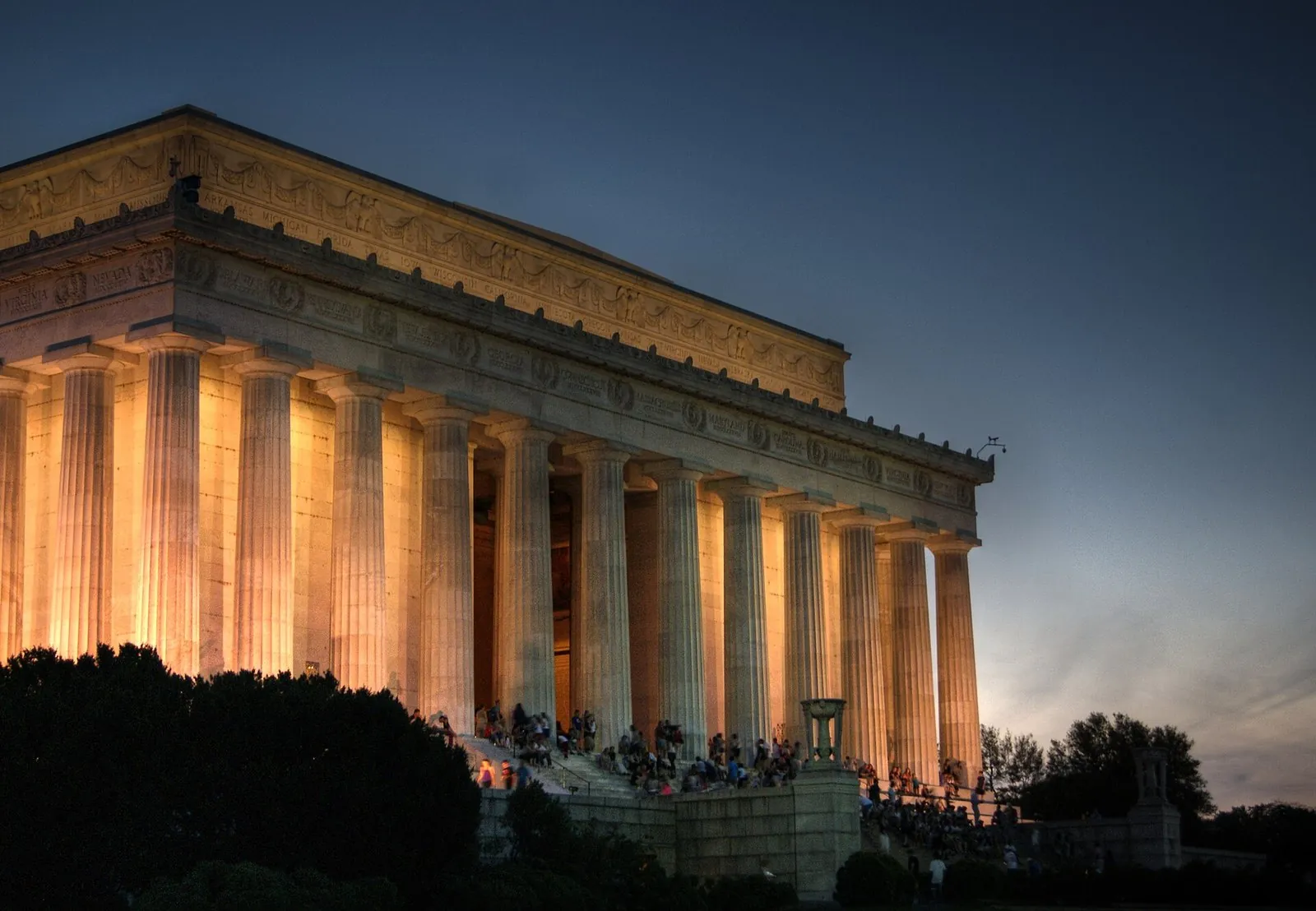
Most people do the Lincoln Memorial the same way: climb the steps, look up at the statue, turn around for the photo of the Washington Monument across the water, and leave. That’s ten minutes well spent, and it misses most of what’s here. There’s a carving mistake on the north wall that the stonecutters never fully hid, an inscription on the steps marking where Martin Luther King Jr. stood in 1963, the names of 48 states carved where almost nobody looks, and a view off the back that explains why the memorial sits exactly where it does. Since June 2026 there’s even a museum in the foundations under your feet. It’s free, it never closes, and it’s one of the few Washington DC monuments that’s better at 6 a.m. and 10 p.m. than at noon.
Quick answer: The Lincoln Memorial is free and open 24 hours a day with no tickets needed; only the new undercroft exhibit beneath the chamber requires a free timed ticket. Allow 30 to 45 minutes, and go at sunrise for the light and the quiet or after dark for the lit statue. The nearest Metro station is Foggy Bottom-GWU (Blue, Orange and Silver lines), about a 20-minute walk.
Last updated September 30, 2026. Hours, access, facilities and the Reflecting Pool’s status were checked that day against the National Park Service’s own pages. Check the Park Service’s alerts page before an early or late visit.
- Cost: free. The memorial needs no tickets; the undercroft exhibit, open since June 2026, needs a free timed ticket ($1 service fee per online reservation).
- Hours: open 24 hours a day; rangers on duty 9:30 a.m. to 11:30 p.m. daily, per the Park Service (as of September 2026).
- Accessibility: an elevator in the lower lobby, in the southeast corner of the building, reaches the chamber.
- Steps: 58 from the chamber down to the plaza, 87 all the way to the Reflecting Pool.
- Metro: Foggy Bottom-GWU, about 20 minutes on foot; Smithsonian, about 25 to 30 minutes along the Mall.
On this page: At a glance | Hours and rangers | What to see | The undercroft | Sunrise or night | The Reflecting Pool | Getting there | Access and restrooms | Nearby memorials | A short history | What to skip | FAQ
The Lincoln Memorial at a glance
| What you need to know | Details (as of September 2026) |
|---|---|
| Cost | Free. No tickets for the memorial itself. |
| Undercroft exhibit | Free timed ticket: Recreation.gov up to 30 days ahead ($1 per reservation), or free same-day tickets from 8:45 a.m. at the Korean War Veterans Memorial kiosk. |
| Hours | Open 24 hours a day, every day. |
| Rangers | On duty 9:30 a.m. to 11:30 p.m. daily, per the Park Service. |
| Time needed | 30 to 45 minutes; an hour with the steps, the back terrace and the lower lobby. |
| Best time | Sunrise for light and quiet; after dark for the lit statue. |
| Metro | Foggy Bottom-GWU (Blue, Orange, Silver lines), about a 20-minute walk. |
| Facilities | Elevator and restroom in the lower lobby (southeast corner); bookstore at chamber level (northeast corner). |
| Phone | Park information line, 202-426-6841. |
Lincoln Memorial hours, tickets and rangers
The Lincoln Memorial is open 24 hours a day, 365 days a year, like the other memorials in National Mall and Memorial Parks. There’s nothing to book and nothing to pay for the memorial itself. You can walk up the steps at 3 a.m. if you want to, and on summer nights plenty of people do.
What changes with the hour is the staffing. The Park Service lists rangers on duty to answer questions from 9:30 a.m. to 11:30 p.m. daily, as of September 2026. Outside those hours the memorial is still open and lit, but there’s no one to ask, and the bookstore in the chamber is closed. If you have questions about the building, the inscriptions or the history, come while a ranger is there; the rangers at this memorial field the same questions all day and tend to have very good answers.
The memorial rarely closes, but it does happen, usually for a major event, a demonstration permit or work on the building or grounds. The Park Service posts closures on the Lincoln Memorial’s alerts and conditions page.
What to see at the Lincoln Memorial, and what most people miss
The building is a Greek temple designed by Henry Bacon, with Daniel Chester French’s seated Lincoln at its center and two of Lincoln’s speeches carved into the side walls. Here’s what to look for, in the order you’ll meet it walking in.
1. The statue, and what the hands mean
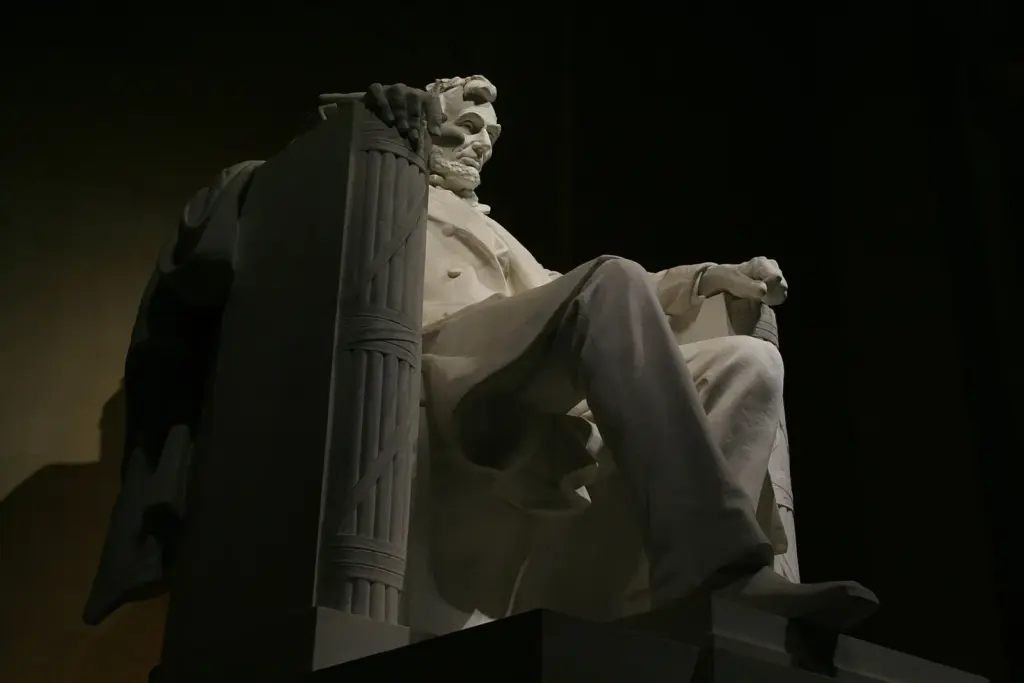
Look at the hands before you take the photo. Daniel Chester French’s Lincoln was carved from 28 blocks of Georgia white marble, and the joints are nearly invisible from the floor. Lincoln sits forward in a large chair, looking east down the Mall toward the Capitol. His left hand is clenched; his right hand is curled around the end of the armrest with the index finger slightly lifted. French meant the posture to show Lincoln’s physical and mental strength and his confidence.
You’ll hear two myths on the steps. The first is that the hands are signing Lincoln’s initials in sign language. The Park Service says no. The second is that the back of Lincoln’s head hides a carved profile of Robert E. Lee. Also no: the Park Service says the only intentional shapes back there are the waves and tufts of Lincoln’s hair. Tell the tour group next to you; they’ll love it.
Plan it: chamber level, center; free, open 24 hours. Allow 10 minutes. Best for: first-timers, night visits.
2. The Gettysburg Address on the south wall
The whole speech fits on one panel. Stand in front of the south wall, on your left as you face the statue, and read it. It takes about two minutes, which is roughly how long Lincoln took to deliver it at Gettysburg in November 1863, and it lands differently in this room than it did in school. Look up: a painted mural by Jules Guerin runs above the inscription.
Plan it: chamber level, south wall, on your left as you face the statue; free, open 24 hours. Allow 5 minutes. Best for: first-timers, teens, history buffs.
3. The Second Inaugural Address, and the “EUTURE” mistake
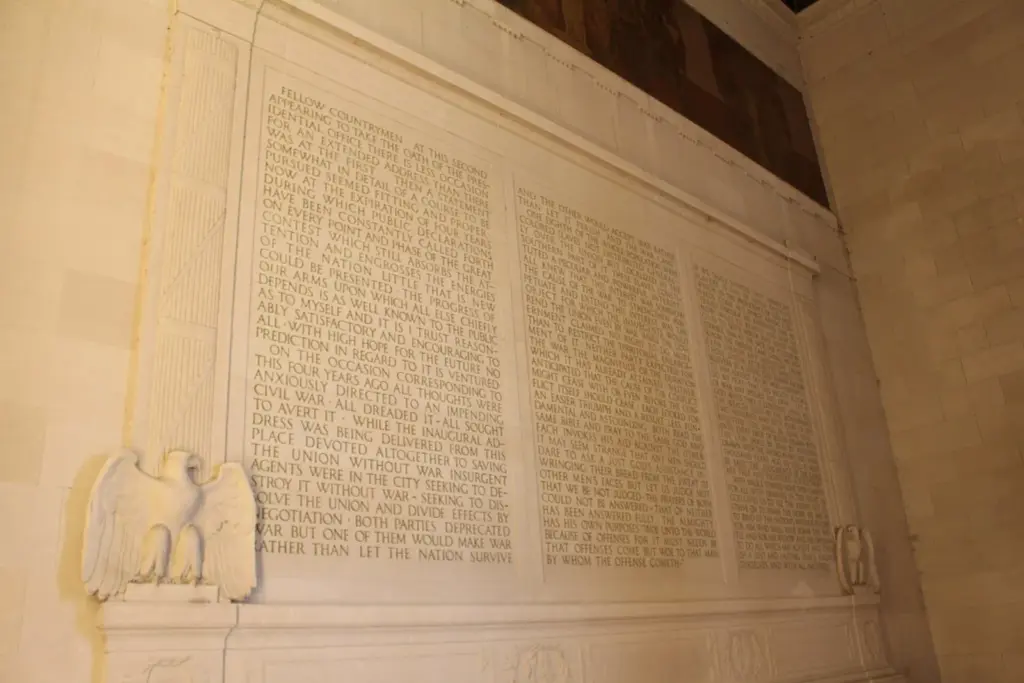
The most famous typo in Washington. The north wall, on your right as you face the statue, carries Lincoln’s Second Inaugural Address of March 1865, the speech whose closing paragraph begins “With malice toward none, with charity for all.” It’s much longer than the Gettysburg Address, and it’s worth reading for the argument Lincoln makes about the war. It’s also where the carvers slipped. In the word “FUTURE,” they cut an E instead of an F, turning it into “EUTURE.” The extra bottom stroke was later filled in, but it’s still visible if you know where to look: scan the text for “FUTURE” and look closely at the first letter.
Plan it: chamber level, north wall, on your right as you face the statue; free, open 24 hours. Allow 10 minutes. Best for: first-timers, families with sharp-eyed kids.
4. The dedication above Lincoln’s head
The words everyone photographs and nobody reads. Carved on the wall above the statue: “In this temple, as in the hearts of the people for whom he saved the Union, the memory of Abraham Lincoln is enshrined forever.” It’s the thesis of the whole building. The memorial isn’t a tomb (Lincoln is buried in Springfield, Illinois); it’s a temple, and the inscription says so.
Plan it: chamber level, above the statue; free, open 24 hours. Allow 2 minutes. Best for: everyone.
5. The 36 columns and the 48 state names
Walk back out and look up. The 36 columns around the outside stand for the 36 states in the Union when Lincoln died in 1865. Above them, carved around the top of the building, are the names of the 48 states in the Union when the memorial was dedicated in 1922. Most visitors never raise their eyes that high. While you’re looking at the stone, note that the building draws on five states: Colorado white marble outside, Indiana limestone for the interior walls and columns, Georgia white marble for the statue, Tennessee pink marble on the chamber floor and Alabama marble in the skylights.
Plan it: the exterior colonnade and the top of the steps; free, open 24 hours. Allow 5 minutes. Best for: first-timers, architecture fans.
6. The “I Have a Dream” marker on the steps
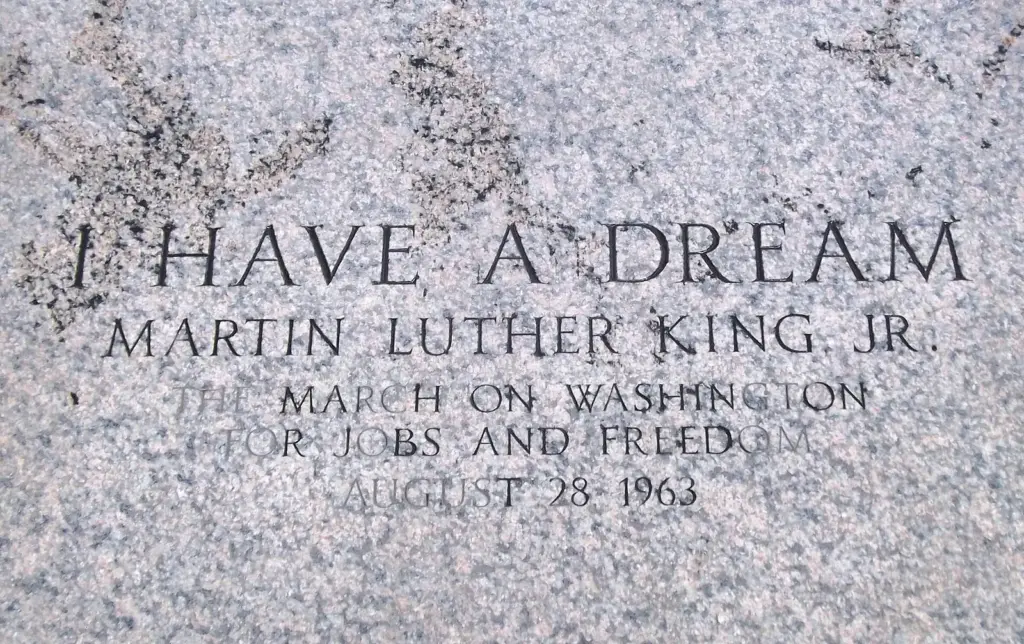
Look down, not up. On August 28, 1963, Martin Luther King Jr. delivered his “I Have a Dream” speech from these steps during the March on Washington for Jobs and Freedom. An engraved inscription on the landing partway down the front steps marks the spot where he stood. It’s set into the stone at your feet, so hundreds of people walk across it every hour without noticing. Stand on it, turn around, and look down the Mall toward the Washington Monument: that was his view of a crowd that filled both sides of the Reflecting Pool.
Plan it: the landing on the front steps, below the chamber; free, open 24 hours. Allow 5 minutes. Best for: everyone.
7. The view off the back
Walk around the colonnade to the west side. Most visitors never leave the front. From the back terrace you look straight across the Potomac along Arlington Memorial Bridge toward Arlington House on the hill, the former home of Robert E. Lee, now inside Arlington National Cemetery. The bridge was built to link the two, the Union’s president and the Confederacy’s general, as a symbol of a reunited country. It’s the quietest side of the memorial, and at sunset it’s the best one.
Plan it: the west terrace, reached around the colonnade; free, open 24 hours. Allow 10 minutes. Best for: couples, photographers, sunset.
A 45-minute visit, in order
If you only have one pass through the memorial, this order catches everything above without doubling back:
- Approach from the Reflecting Pool. Walk the last stretch from the east so the building grows in front of you, the way Bacon intended.
- Stop at the landing. Find the “I Have a Dream” marker partway up the steps, stand on it and look back down the Mall.
- Climb to the colonnade and look up at the state names above the 36 columns before you go inside.
- In the chamber, take in the statue from the center, then read the Gettysburg Address on your left and hunt for “EUTURE” in the Second Inaugural on your right.
- Read the dedication above Lincoln’s head on your way out.
- Walk around the colonnade to the back terrace for the view across Memorial Bridge to Arlington House.
- Finish in the lower lobby (restroom, elevator), add the undercroft exhibit if you have tickets, then head for the Korean War or Vietnam Veterans memorial.
If a ranger is on duty in the chamber, add ten minutes for questions. It’s the best free talk on the Mall.
The undercroft: the new museum beneath the memorial
Under the chamber is the undercroft, the cavernous space where a soaring grid of concrete columns holds the whole building up. For most of the memorial’s first century, the public saw it only on rare ranger-led tours. That changed in 2026, when the Park Service opened a 15,000-square-foot exhibit down there, on June 25, 2026, according to news reports of the opening. Interactive exhibits explain how the memorial was built, and multimedia presentations trace its role in American history and the civil rights movement. The columns alone are worth the trip.
Free timed ticket required. Unlike the memorial above it, the undercroft needs a ticket for everyone age 2 and older. As of September 2026, per the Park Service’s undercroft page:
- In advance: reserve on Recreation.gov or by phone at 877-444-6777, up to 30 days ahead. New tickets are released at 11 a.m. daily. Tickets are free, but there’s a $1.00 service fee per reservation, and each reservation covers up to six people.
- Same day: free walk-up tickets are handed out at the Korean War Veterans Memorial kiosk on Daniel Chester French Drive, just south of the Lincoln Memorial, starting at 8:45 a.m. daily. One person aged 16 or older can collect up to six.
- Groups: up to 50 tickets, reserved up to 30 days ahead on Recreation.gov. Large groups can’t use walk-up tickets.
The Park Service’s page doesn’t list the undercroft’s opening hours or its entrance, so check your reservation confirmation or ask a ranger on the day, and budget extra time on top of your visit to the chamber. The walk-up kiosk fits neatly after a sunrise visit: see the memorial empty at dawn, then be at the Korean War Veterans Memorial for 8:45 a.m.
Sunrise, sunset or night: when to visit the Lincoln Memorial
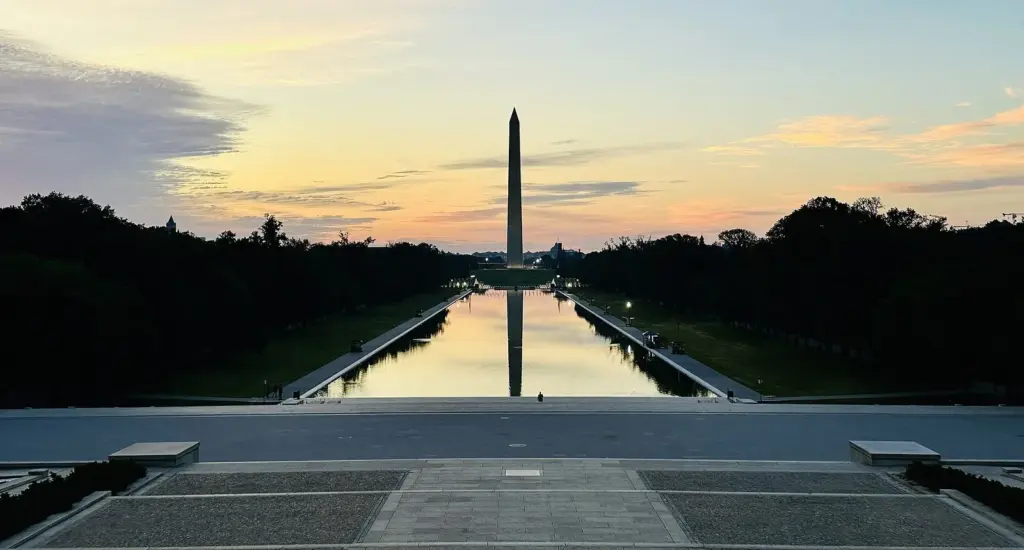
The memorial faces east, straight down the Mall, so the time of day changes everything.
Sunrise is the best time, full stop. The sun comes up behind the Washington Monument, the front of the memorial takes the first light, and the steps are nearly empty. Sunrise is around 5:45 a.m. in June and after 7 a.m. for most of late fall and winter. Rangers aren’t on duty yet, but you don’t need them for this. Bring a coffee and sit on the steps.
Midday is the worst time. From late morning through mid-afternoon, tour buses and school groups arrive in waves, especially from March through June, and the chamber gets crowded enough that reading the walls becomes a contact sport. In summer the plaza and steps have almost no shade, and the heat is real.
Sunset belongs to the back terrace. Because the front faces east, the building is backlit at sunset. Walk around to the west side and watch the sun drop over the Potomac and Arlington, or stand at the far end of the Reflecting Pool and watch the memorial go dark against the sky.
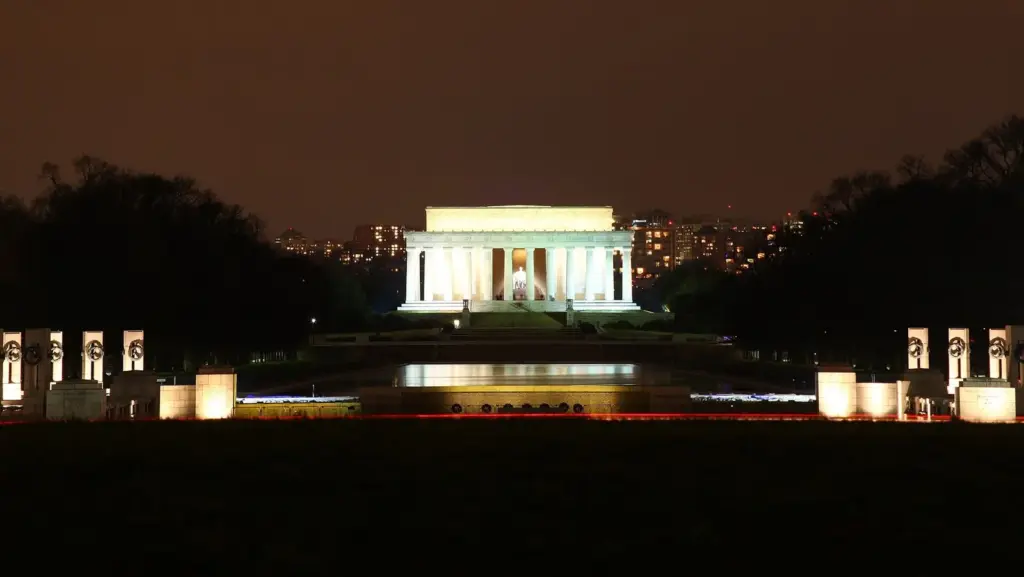
Night is a close second to sunrise. The statue is lit from above, the chamber glows from a mile away, and the crowds thin out after about 9 p.m. The Park Service lists rangers on duty until 11:30 p.m., which makes this one of the few Washington sights where you can still ask questions late at night. It’s also the natural finale of an evening walk past the Mall’s memorials.
Photographing the Lincoln Memorial
This is one of the most photographed buildings in the country, so the classic shots are easy to get and hard to make your own. Four places to stand:
- The top of the steps, looking east, at sunrise. The Washington Monument and its reflection line up down the length of the pool. This is the shot in the sunrise photo on this page.
- The east end of the Reflecting Pool, looking west, after dark. The lit memorial doubles in the water. Go on a still night; the slightest wind breaks the reflection.
- The chamber floor, looking up at the statue. Stand back near the columns rather than at the front rail; a wider frame shows the scale of the room and the dedication above Lincoln’s head.
- The back terrace at sunset, looking west across the Potomac toward Arlington, with the river catching the last light.
Midday light is flat and harsh from every angle, and the steps are full of other people’s photos in progress. If you can only come at noon, go inside, where the light is soft and constant, and save the exterior for another pass at night.
The Reflecting Pool in 2026
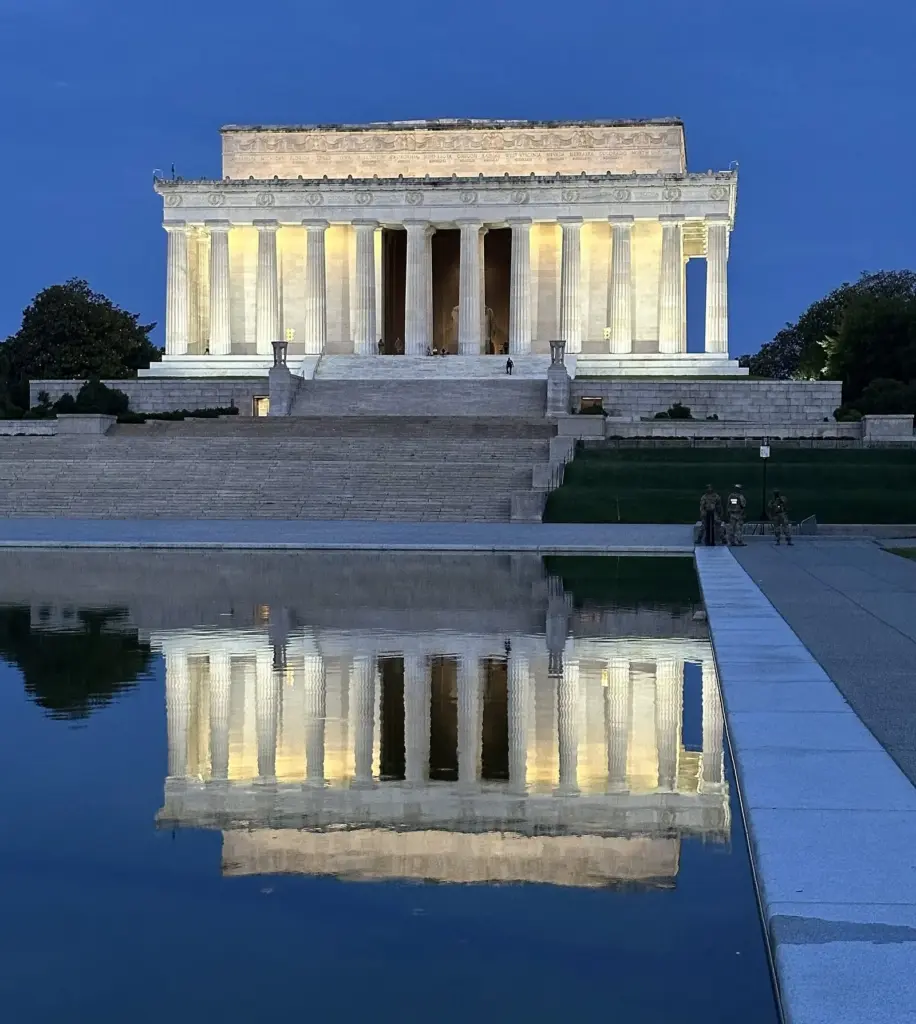
If your last visit was before 2026, the Reflecting Pool below the steps will look different. The Park Service closed and drained it from April 10, 2026 for cleaning, joint repairs and a new lining, and it was resurfaced with a blue coating, a change ordered by the Trump administration, before being refilled in early June 2026. Closures around the work were posted through September 10, 2026; check the Park Service’s alerts pages for anything newer.
The pool itself runs from the foot of the memorial’s steps toward the World War II Memorial, and the view down it from the top of the steps is the one everyone comes for. Check the Park Service alerts before you go, since work around the pool can close sections of the walkways.
Getting to the Lincoln Memorial: Metro, bus and parking
The Lincoln Memorial sits at the far western end of the National Mall, and no Metro station is close. Plan on a walk.
- Foggy Bottom-GWU (Blue, Orange and Silver lines) is the nearest station: walk south on 23rd Street NW for about 20 minutes.
- Smithsonian (Blue, Orange and Silver lines) puts you on the Mall itself. The walk west past the Washington Monument, the World War II Memorial and the Reflecting Pool takes 25 to 30 minutes, and it’s the better walk, since you pass half the Mall’s memorials on the way.
- Buses: the DC Circulator’s National Mall route ended when the Circulator shut down on December 31, 2024, and there’s no dedicated replacement loop on the Mall. Metrobus routes serve the area; use WMATA’s trip planner for the current route.
- Driving: parking near the memorial is limited to scarce street spaces, and they fill early on busy days. If you must drive, go at sunrise, when you’ll have your pick.
A rideshare or taxi to the memorial is the easy option for a sunrise visit, when the Metro walk in the dark is less appealing. Ask to be dropped as close to the front steps as the driver can manage; the circle around the memorial is busy with traffic, so follow the crosswalks rather than cutting across.
Accessibility, restrooms and the steps
There are 58 steps from the chamber down to the plaza and 87 from the chamber all the way down to the Reflecting Pool. You don’t have to climb any of them. The Park Service says the elevator is in the lower lobby in the southeast corner of the building, and it runs up to the chamber level. The southeast corner is front left as you face the memorial from the Reflecting Pool.
The restroom is in the same place, the lower lobby in the southeast corner. Use it before you set off on the loop of nearby memorials.
The bookstore is in the northeast corner of the chamber level, and it’s a good stop for Lincoln books and souvenirs that aren’t made in bulk for the Mall kiosks. Hours are shorter than the memorial’s, so don’t count on it at night.
Visiting the Lincoln Memorial with kids
Children tend to like the Lincoln more than parents expect, as long as you give them a job. Three that work:
- The typo hunt. Tell them there’s a spelling mistake carved into the north wall and let them find “EUTURE” themselves. It can take a while, which is the point.
- Count the steps. There are 58 from the chamber to the plaza and 87 all the way down to the pool, per the Park Service. Kids will check.
- The $5 bill. Bring one and hold it up against the real building. It’s the same view.
The steps are wide and busy, so hold small hands on the way down, and use the elevator in the lower lobby if you have a stroller. Early morning and evening visits beat midday with children, too: cooler, calmer and easier to keep everyone together. The Einstein Memorial, a 10-minute walk north, makes a good reward afterward, since climbing onto the statue is part of the experience.
Nearby memorials in walking order
The Lincoln Memorial anchors a cluster of memorials at the west end of the Mall, all within 15 minutes’ walk. A sensible loop from the steps:
- Korean War Veterans Memorial, southeast of the Lincoln, about 5 minutes. The 19 stainless-steel soldiers walking through juniper are at their eeriest in fog, rain or darkness.
- Vietnam Veterans Memorial, northeast of the Lincoln, about 5 minutes. The black granite wall carries the names of more than 58,000 Americans; walk it from one end to the other.
- The Albert Einstein Memorial, north on Constitution Avenue in front of the National Academy of Sciences, about 10 minutes. Children climb onto his lap; nobody minds.
- World War II Memorial, at the east end of the Reflecting Pool, 10 to 15 minutes along the pool.
- The Washington Monument, another 10 minutes east. Going up takes a timed ticket: book ahead online for a $1 fee, or line up for a free same-day ticket at the Washington Monument Lodge on 15th Street from 8:45 a.m.
To the south, the Martin Luther King Jr. Memorial on the Tidal Basin is about 10 minutes’ walk from the Lincoln, and it’s the natural next stop after the “I Have a Dream” marker. From there the Tidal Basin loop continues to the FDR and Jefferson memorials.
A short history of the Lincoln Memorial
Construction began in 1914 on land that had been Potomac marsh a generation earlier, and the memorial was dedicated on May 30, 1922. Henry Bacon designed the building as a Greek Doric temple; Daniel Chester French designed the statue. The site at the far end of the Mall was chosen to complete the line from the Capitol through the Washington Monument, and the building has been the Mall’s western bookend ever since.
The memorial became a stage almost immediately. On Easter Sunday 1939, the contralto Marian Anderson sang from its steps after she was barred from performing at Constitution Hall because she was Black. Twenty-four years later, the March on Washington ended here with King’s speech. The steps have hosted protests, concerts and inaugural events ever since, which is why the building feels less like a monument and more like a public square. Check the back of a $5 bill before you go; the memorial’s on it.
For the rest of Lincoln’s Washington, including Ford’s Theatre, the Petersen House where he died and President Lincoln’s Cottage, see our guide to historic sites in Washington DC.
What to skip, and what’s changed
- Skip midday in summer. No shade, big crowds, and the worst light for photos.
- Skip the “sign language” and “Robert E. Lee” stories. The Park Service has debunked both.
- Skip driving. Parking is scarce; walk from the Mall or take a rideshare.
- Don’t leave from the front. The back terrace and the lower lobby are the parts most people miss.
- What’s changed: the undercroft opened to the public as an exhibit in June 2026, with timed tickets; the Reflecting Pool was resurfaced blue and refilled in June 2026; the DC Circulator no longer runs on the Mall; the Tidal Basin seawall rebuild to the south was finished in December 2025, so older construction warnings for the walk to the MLK and Jefferson memorials are out of date.
The Lincoln is the best of the Mall’s memorials, but it’s the start of a walk, not the whole walk. Our guide to the monuments and memorials on the National Mall lays out the full route, including the best order at night.
Lincoln Memorial FAQ
Is the Lincoln Memorial open 24 hours?
Yes. The Lincoln Memorial is open 24 hours a day, every day, and it’s lit at night. As of September 2026, the Park Service lists rangers on duty to answer questions from 9:30 a.m. to 11:30 p.m. daily. The bookstore keeps shorter hours. Check the Park Service’s alerts page for rare closures for events or work.
Do you need tickets for the Lincoln Memorial?
Not for the memorial itself: it’s free and open at any hour with no reservations. The exception is the undercroft exhibit beneath the chamber, open since June 2026, which needs a free timed ticket from Recreation.gov ($1 service fee per reservation) or a free same-day ticket from the Korean War Veterans Memorial kiosk from 8:45 a.m.
Where did Martin Luther King Jr. give the “I Have a Dream” speech?
From the steps of the Lincoln Memorial, on August 28, 1963, at the end of the March on Washington for Jobs and Freedom. An engraved inscription on the landing partway down the front steps marks the spot where he stood. It’s set into the stone at your feet, so look down.
What is the mistake on the Lincoln Memorial?
In the Second Inaugural Address on the north wall, the carvers cut the word “FUTURE” with an E instead of an F, making “EUTURE.” The extra stroke was later filled in, but it’s still visible up close. Look for the word “future” in the text and check its first letter.
Is there an elevator at the Lincoln Memorial?
Yes. The Park Service says the elevator is in the lower lobby in the southeast corner of the building, and it reaches the chamber level, so you can see the statue without climbing the 58 steps from the plaza. The restroom is in the same lower lobby.
What is the closest Metro station to the Lincoln Memorial?
Foggy Bottom-GWU, on the Blue, Orange and Silver lines, about a 20-minute walk south on 23rd Street. Smithsonian station, on the same lines, is 25 to 30 minutes away, but that walk runs along the Mall past the Washington Monument, the World War II Memorial and the Reflecting Pool.
Can you go under the Lincoln Memorial?
Yes, since June 2026. The undercroft, a 15,000-square-foot space of concrete columns beneath the chamber, is now an exhibit on how the memorial was built and what it has meant. Everyone 2 and older needs a free timed ticket: reserve on Recreation.gov up to 30 days ahead, or collect same-day tickets from 8:45 a.m.
How long do you need at the Lincoln Memorial?
Plan 30 to 45 minutes for the statue, both inscriptions, the “I Have a Dream” marker and the view down the Mall. Allow an hour if you add the back terrace and the lower lobby, and longer if you continue to the Korean War and Vietnam Veterans memorials nearby.
Related Washington DC Guides
- Washington DC Monuments and Memorials: every memorial on the Mall and the Tidal Basin, with a walking route and the best order at night.
- Historic Sites in Washington DC: Ford’s Theatre, President Lincoln’s Cottage and the rest of the city’s history beyond the Mall.
Sources and How We Checked
Every hour, facility location and closure on this page was checked on September 30, 2026 against the National Park Service pages below; the page was compiled from those sources, and we don’t claim first-hand visits.
- National Park Service: Lincoln Memorial frequently asked questions
- National Park Service: Lincoln Memorial operating hours
- National Park Service: Lincoln Memorial alerts and conditions
- National Park Service: Explore the Lincoln Memorial Undercroft
- National Park Service: Lincoln Memorial
- National Park Service: National Mall and Memorial Parks hours
We also used WMATA’s station information, DDOT’s notice on the end of the DC Circulator, and NPR’s reporting on the 2026 Reflecting Pool resurfacing.
Washington DC Tourism Guide is an independent publication. We are not affiliated with Destination DC, the National Park Service, the Smithsonian Institution or any attraction listed here, and no one paid to be included.
Photo Credits
- The Lincoln Memorial colonnade in the evening: photo by Erich Robert Joli Weber, via Wikimedia Commons (CC BY-SA 3.0)
- The statue of Abraham Lincoln: photo by Gregory Varnum, via Wikimedia Commons (CC BY-SA 3.0)
- The Second Inaugural Address inscription: photo by NPS, via Wikimedia Commons (Public domain)
- The I Have a Dream inscription: photo by ProhibitOnions; cropped by Beyond My Ken (talk) 01:40, 15 February 2012 (UTC), via Wikimedia Commons (GFDL)
- Sunrise from the Lincoln Memorial steps: photo by APK, via Wikimedia Commons (CC BY 4.0)
- The Lincoln Memorial at night: photo by Bradley Weber, via Wikimedia Commons (CC BY 2.0)
- The resurfaced Reflecting Pool: photo by APK, via Wikimedia Commons (CC BY 4.0)