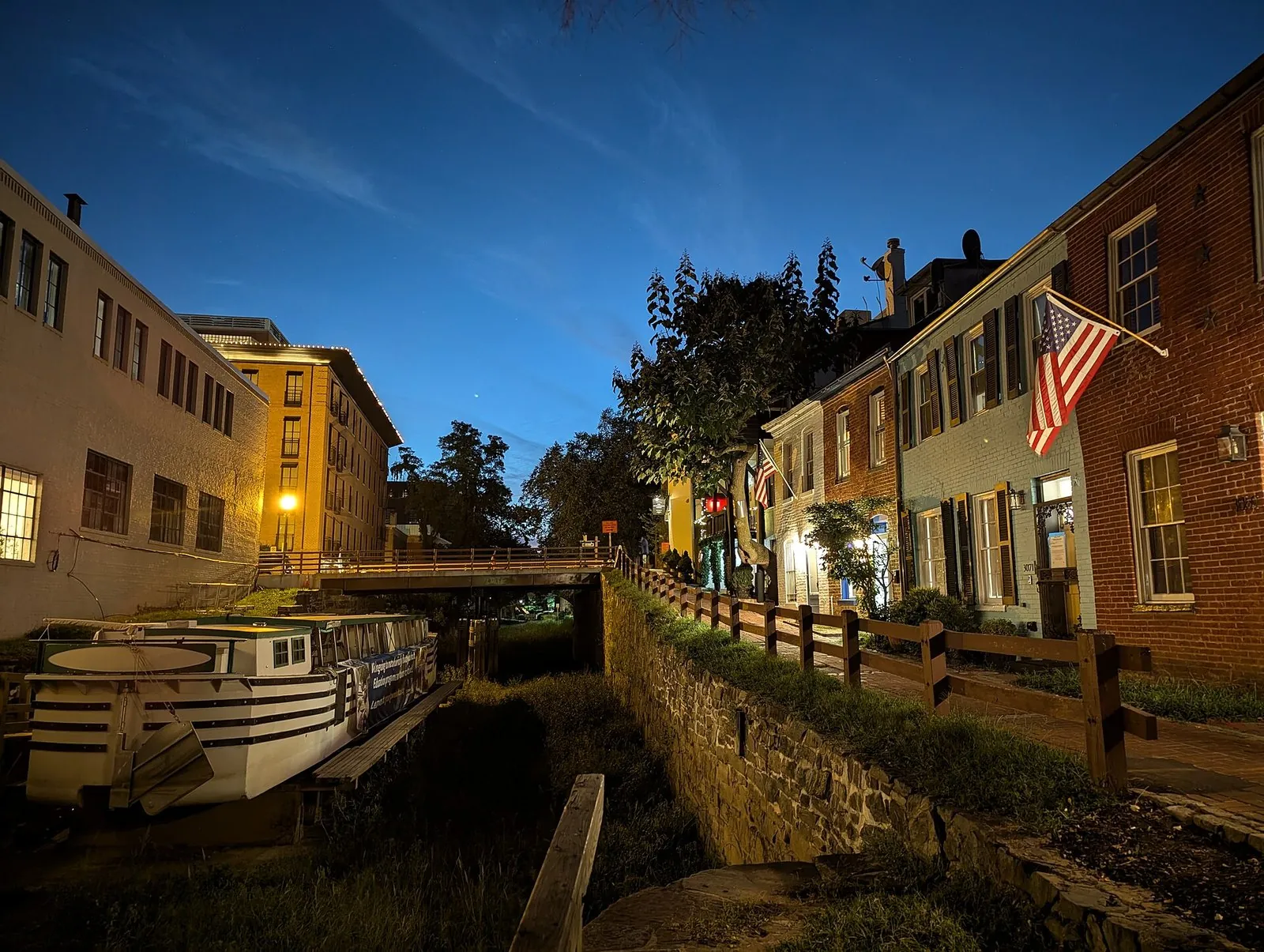
Georgetown DC is older than Washington itself, and it still acts like it. It was a Maryland tobacco port by 1751, four decades before anyone chose a site for the capital, and its brick rowhouses, cobbled side streets and canal still run on a smaller, older scale than the rest of the city. It’s also the one famous DC neighborhood without a Metro station, which keeps it slightly apart. That’s half the appeal and most of the planning. Once you know how to get in and where to walk, it’s the best neighborhood in the city for an unhurried day of history, food, shopping and river views.
Quick answer: Georgetown is DC’s oldest neighborhood, known for shopping on M Street and Wisconsin Avenue, the C&O Canal, the Potomac waterfront, Georgetown University and historic estates like Dumbarton Oaks and Tudor Place. There’s no Metro station, so walk about 15 minutes from Foggy Bottom-GWU or cross Key Bridge from Rosslyn. Allow half a day, or a full day with a house tour.
Last updated September 24, 2026. Hours, fares and prices below were checked that day against the attractions’, the National Park Service’s and WMATA’s own websites.
- No Metro: Foggy Bottom-GWU is about a 15-minute walk; Rosslyn is a walk across Key Bridge. Metrobus lines A58, C91, D80, D82, D94 and D96 serve the neighborhood.
- By water: the Potomac Water Taxi runs from the Wharf in about 30 minutes, roughly $22 one way, from March to December.
- Free: the waterfront, the canal towpath, the Old Stone House and the Dumbarton Oaks Museum.
- Paid: Tudor Place’s guided house tours and, in season, the Dumbarton Oaks gardens ($15 in 2026).
- Winter: the Georgetown GLOW light festival took a break in 2025; check the Georgetown BID’s site to see whether it returns.
On this page: At a glance | What it’s known for | History | Getting there | Things to do | Walking route | A day, hour by hour | Where to eat | Shopping | At night | Seasons | With kids | What to skip | FAQ
Georgetown at a glance
| What | Details (as of September 2026) |
|---|---|
| Nearest Metro | Foggy Bottom-GWU (Blue, Orange, Silver lines), about a 15-minute walk; Rosslyn, across Key Bridge |
| Buses | Metrobus A58, C91, D80, D82, D94 and D96 |
| Water taxi | From the Wharf, about 30 minutes, about $22 one way, March to December |
| Main streets | M Street NW and Wisconsin Avenue NW |
| Time needed | Half a day; a full day with Dumbarton Oaks or Tudor Place |
| Cost | Free to walk; house museums range from free to paid |
| Best for | History, shopping, food, river walks, couples |
| Best time | Weekday mornings; spring and fall |
| Driving | Paid garages and scarce street parking; not recommended |
What is Georgetown DC known for?
Start with age. Georgetown grew up as a river port where tobacco from Maryland farms was loaded onto ships, and it was a going concern before the federal city existed. When the District was laid out in the 1790s, Georgetown was swept inside its boundary, but it kept its own government until 1871. Walk the side streets north of M Street and you’re looking at the result: Federal-era brick houses, some of the oldest buildings in the city, and a street grid that predates L’Enfant’s plan.
Then the canal and the river. The Chesapeake and Ohio Canal, begun in 1828, was supposed to link Georgetown with the Ohio River; it made it as far as Cumberland, Maryland, and carried coal and grain into town until 1924. Today it’s a national historical park, and its towpath is one of the best walks in the city. Down on the Potomac, the waterfront has turned from warehouses into a long riverside park.
Then the people. Georgetown University, founded in 1789, is the oldest Catholic and Jesuit university in the country, and its spires dominate the western end of the neighborhood. In the mid-20th century Georgetown became the address of choice for Washington’s political class: John F. Kennedy lived on N Street as a senator, and the dinner-party Georgetown of that era is still part of its reputation. Hollywood noticed too. The steep staircase at the end of M Street became famous in The Exorcist in 1973, and fans still climb it.
And finally, shopping and food. M Street and Wisconsin Avenue form the city’s best-known shopping district, with national brands on the main streets and independent shops and galleries on the quieter stretches. It’s also home to some of DC’s longest-running restaurants, and to a cupcake shop that became a reality-TV star; our guide to the best restaurants in DC puts them in context with the rest of the city.
A short history of Georgetown
Georgetown was laid out in 1751 on land along the Potomac at the highest point ships could reach, and Scottish merchants made it a busy tobacco port. The river trade built the Federal-style merchants’ houses that still line its streets. By the 19th century the port was losing ground as the river silted up and railroads took the trade, and the canal, completed to Cumberland in 1850, arrived just as railways made canals obsolete. Georgetown turned industrial, with flour mills, warehouses and a working waterfront along the river and the canal.
It was also home to a large Black community. Mount Zion United Methodist Church, founded in 1816, is the oldest Black congregation in the city, and the area of east Georgetown once known as Herring Hill was a thriving Black neighborhood for more than a century. As Georgetown became fashionable in the 1930s and after, rising prices and property purchases pushed most of those families out, a history the neighborhood’s walking tours and churches still tell.
In 1950 Congress passed the Old Georgetown Act, which made the neighborhood a protected historic district and put changes to its buildings under federal design review. That’s why Georgetown still looks the way it does, with low rooflines, brick facades and no towers, and why even the chain stores on M Street sit behind old storefronts.
How to get to Georgetown (there’s no Metro)
Georgetown residents famously fought a Metro station in the 1960s and 1970s, or so the story goes; the more mundane reasons had to do with engineering and routing. Either way, the nearest stations are a walk away, and that walk is part of the experience.
| Option | How it works | Time and cost (September 2026) |
|---|---|---|
| Metro + walk from Foggy Bottom | Foggy Bottom-GWU (Blue, Orange, Silver), then walk west on Pennsylvania Avenue across Rock Creek to M Street | About 15 minutes’ walk; regular Metro fare |
| Metro + walk from Rosslyn | Rosslyn (Blue, Orange, Silver), then cross Key Bridge on foot | About 15 minutes’ walk; regular Metro fare |
| Metrobus | Lines A58, C91, D80, D82, D94 and D96 serve Georgetown | $2.25 |
| Water taxi | Potomac Water Taxi from the Wharf or Old Town Alexandria to Washington Harbour | About 30 minutes from the Wharf; about $22 one way; March to December |
| Bike | Capital Bikeshare, the Rock Creek trail or the C&O towpath | $1 unlock plus 15 cents a minute (classic), or $10 day pass |
| Car or rideshare | Paid garages near M Street; street parking is scarce | Traffic on M Street is slow at peak times |
From Foggy Bottom. This is the most common route. Leave the station, walk west on I Street or Pennsylvania Avenue, cross the bridge over Rock Creek, and you’re at the eastern end of M Street. It’s flat and about 15 minutes to the first shops.
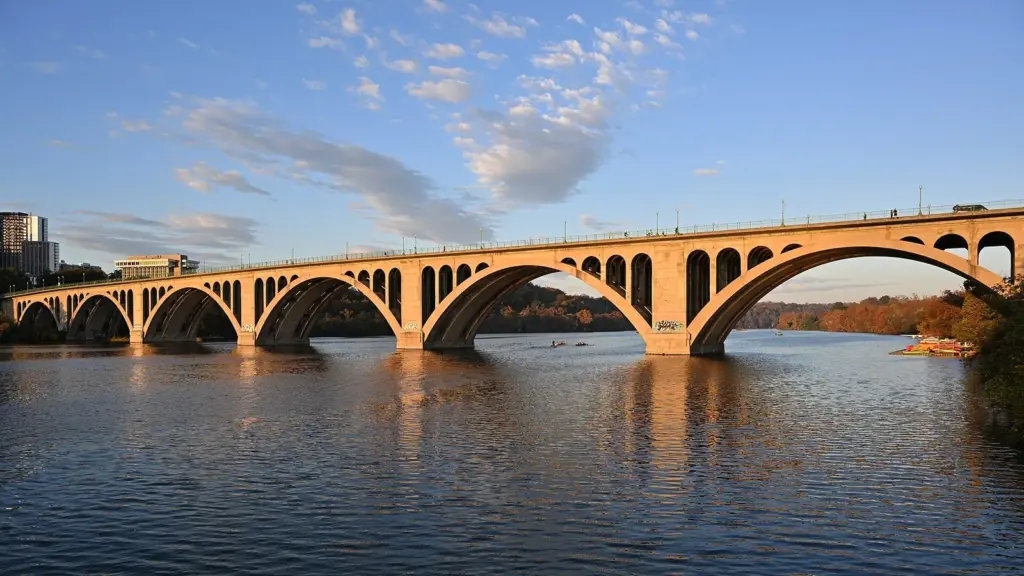
From Rosslyn. Coming from Virginia, or if you’re staying in Arlington, take the Metro to Rosslyn and walk across Key Bridge. It’s a little longer, and the bridge has a good view of the river, the university and the Washington Monument downstream. It’s also the easiest way in from Reagan National Airport: Blue line to Rosslyn, then walk.
By bus. Several Metrobus lines run along M Street and Wisconsin Avenue. They carry new names since WMATA redesigned its bus network in June 2025, so older route numbers in guidebooks won’t help. The DC Circulator, whose Georgetown-Union Station route many guides still mention, stopped running at the end of 2024.
By water. The Potomac Water Taxi links Georgetown’s Washington Harbour dock with the Wharf in about 30 minutes, and with Old Town Alexandria. Departures from the Wharf start late morning and run every 30 to 60 minutes, and the service runs from March to December. Note that the Georgetown dock isn’t ADA compliant. It’s a scenic way to arrive, and a better one to leave at sunset.
From the National Mall. Walking from the Lincoln Memorial takes about 40 minutes along the river past the Kennedy Center. Otherwise take the Metro to Foggy Bottom, or a bus or rideshare.
Things to do in Georgetown DC
These are ranked for a first visit, with the free and easy stops first. You won’t fit them all into one day, and you shouldn’t try. The historic sites keep very different hours, so here they are side by side:
| Site | Open (as of September 2026) | Cost |
|---|---|---|
| Dumbarton Oaks Museum | Tuesday to Sunday, 11:30am to 5:30pm; closed federal holidays | Free |
| Dumbarton Oaks gardens | Tuesday to Sunday, 2pm to 6pm | $15 with a timed ticket in season (2026, through October 31); free in winter |
| Tudor Place | Tuesday to Saturday 10am to 4pm, Sunday noon to 4pm; last house tour 3pm | Paid guided tours |
| Old Stone House | Garden daily, sunrise to sunset; interior hours not posted | Free |
| C&O Canal towpath | Daily | Free |
| Georgetown Waterfront Park | Daily | Free |
1. Walk M Street and Wisconsin Avenue
Free. The two main streets meet at the heart of Georgetown, and walking them is the default Georgetown afternoon. M Street runs along the bottom of the hill, parallel to the river, with shops and restaurants in 18th- and 19th-century buildings. Wisconsin Avenue climbs north from the river toward the quieter, more local end of the neighborhood. The sidewalks are narrow and crowded on weekends, so the side streets are where you’ll want to wander.
Plan it: free; shops generally open late morning to evening. Metro: Foggy Bottom-GWU, about 15 minutes’ walk. Allow 2 hours. Best for: shoppers, first-timers, rainy-day browsing.
2. Georgetown Waterfront Park and Washington Harbour
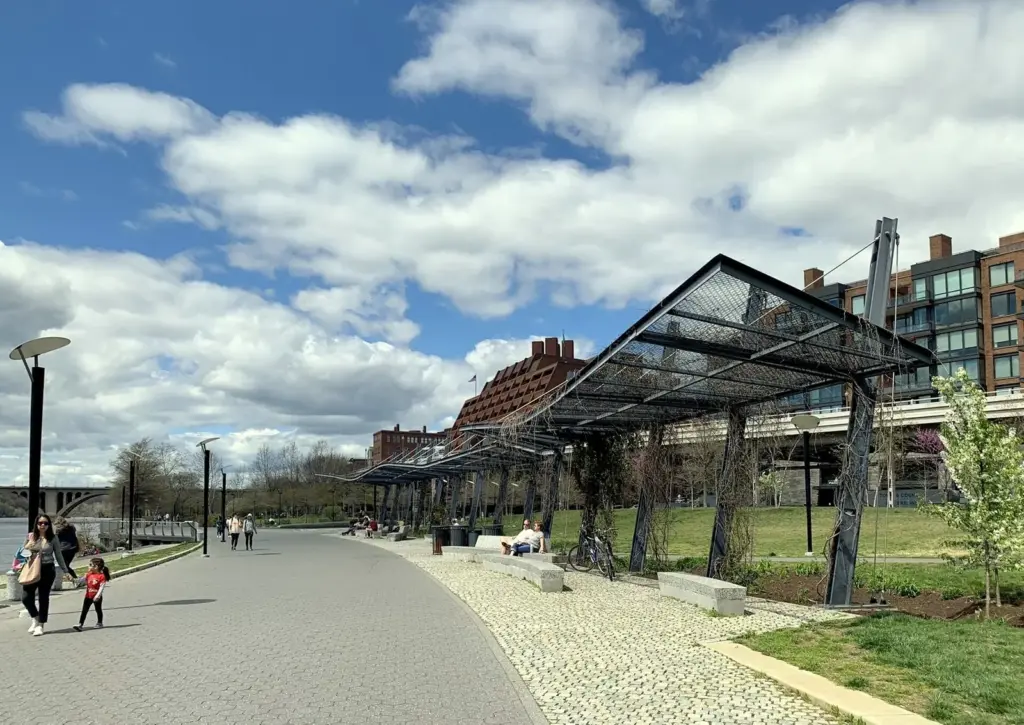
Free. A long riverside park runs along the Potomac between Washington Harbour and Key Bridge, with lawns, a stone labyrinth, a fountain kids run through in summer and steps down toward the water. Washington Harbour, at its eastern end, has restaurants with outdoor tables on the river and the water taxi dock. It’s the best free sunset in Georgetown: the light goes down behind Key Bridge and Roosevelt Island.
Plan it: open all day; free. From M Street, walk down Wisconsin Avenue or 31st Street to the river. Allow 45 minutes to an hour. Best for: couples, families, sunset.
3. The C&O Canal towpath
Free. The canal runs one block north of the river, parallel to M Street, and the towpath beside it is a quiet, shady escape from the crowds just above. Mile zero is near Rock Creek at the eastern end of Georgetown, and the towpath runs for 184.5 miles to Cumberland, Maryland. In Georgetown it passes locks, footbridges and old warehouses; walk west and within 20 minutes you’re among trees. The nonprofit Georgetown Heritage now runs the canal boat program in Georgetown; check its site for the current schedule and prices.
Plan it: free; open daily. Access from 30th, 31st, Thomas Jefferson and Wisconsin streets. Allow 30 minutes to half a day. Best for: walkers, runners, cyclists, families.
4. Dumbarton Oaks
Museum free; gardens paid in season. A Federal-era mansion on the hill, owned by Harvard since 1940, with a small museum of Byzantine and pre-Columbian art and some of the finest gardens in the country, terraced down the slope. The 1944 conference that planned the United Nations was held here. The museum is free and rarely crowded; the gardens are the star from spring to fall.
Plan it: museum 11:30am to 5:30pm Tuesday to Sunday, closed federal holidays, free. Gardens 2pm to 6pm Tuesday to Sunday; in the 2026 regular season, which ends October 31, tickets were $15, bought online in advance only, and in the winter season the gardens are free with no ticket (as listed on doaks.org in September 2026). 1703 32nd St NW. Allow 1.5 to 2 hours. Best for: garden lovers, art lovers, couples.
5. Tudor Place
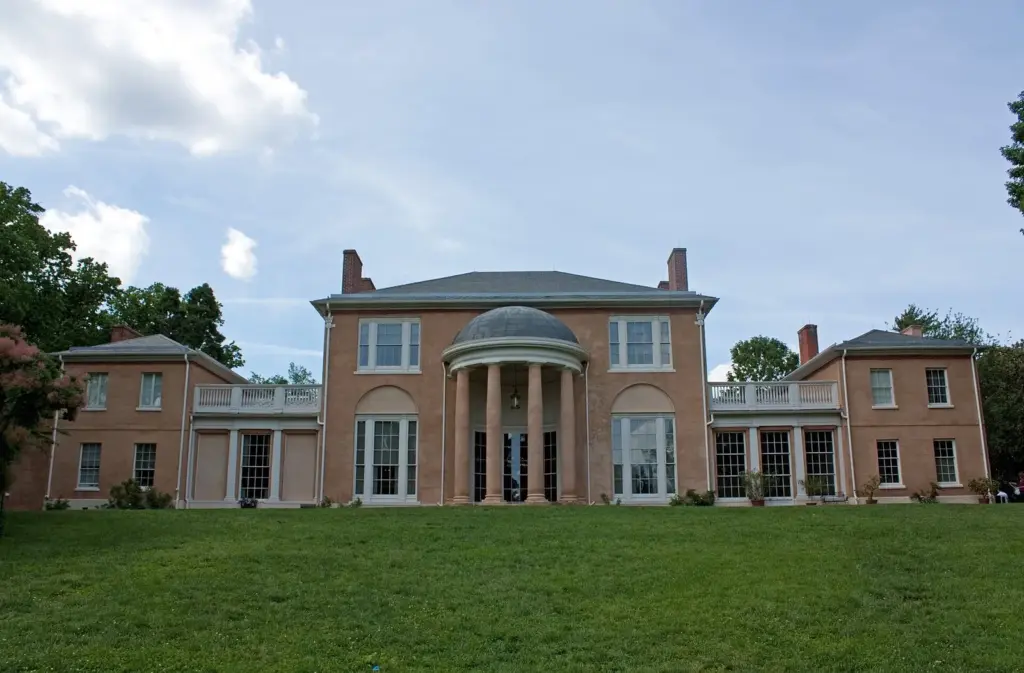
Paid, guided tours. A neoclassical house finished in 1816 and designed by William Thornton, the first architect of the Capitol, for Martha Custis Peter, Martha Washington’s granddaughter. Her family lived here for six generations, which is why the house holds an unusually complete record of Washington life, including objects from Mount Vernon. The five-acre garden is lovely in spring.
Plan it: open Tuesday to Saturday 10am to 4pm and Sunday noon to 4pm; the house is seen on guided tours only, from 10am (noon on Sunday) to a last tour at 3pm (as listed on tudorplace.org in September 2026). Book online up to an hour ahead; walk-ins are welcome as space allows, but reserve on weekends. 1644 31st St NW. Allow 1.5 hours. Best for: history buffs, garden lovers.
6. The Old Stone House
Free. Built in 1765 and run by the National Park Service, it’s the oldest structure in Washington still standing on its original foundation, right on busy M Street. Inside, only the ground-floor kitchen and the front room, a shop of some kind since the early 1800s, were open when the Park Service last updated its page; the garden behind the house is a lovely free place to sit.
Plan it: garden open daily sunrise to sunset; free. Interior hours aren’t posted, so check the Park Service page before you go. 3051 M St NW. Allow 20 minutes. Best for: history buffs, a quiet break.
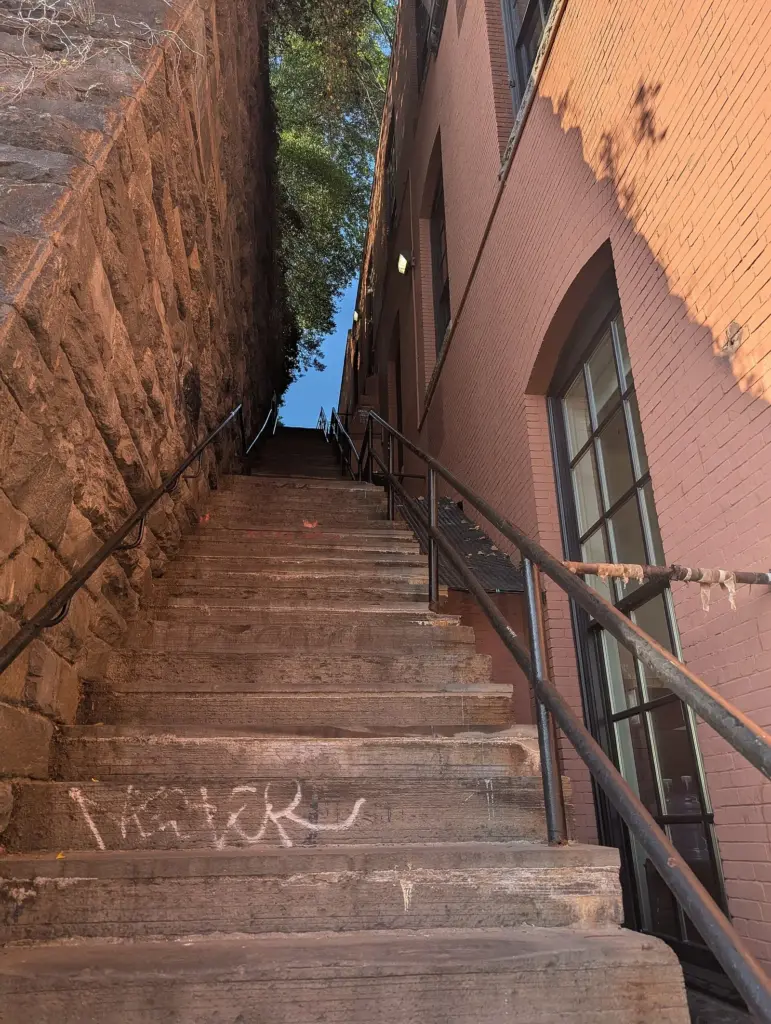
7. The Exorcist Steps
Free. The steep, narrow stone staircase that drops from Prospect Street to M Street at 36th Street is where the climax of The Exorcist was filmed in 1973, and the city put up a plaque in 2015. It’s steep enough that you’ll understand the stunt the moment you look down. Go early or late in the day if you want a photo without strangers in it, and hold the railing.
Plan it: open all day; free. At M Street and 36th Street NW, near Key Bridge. Allow 15 minutes. Best for: film fans, Halloween visitors, anyone with good knees.
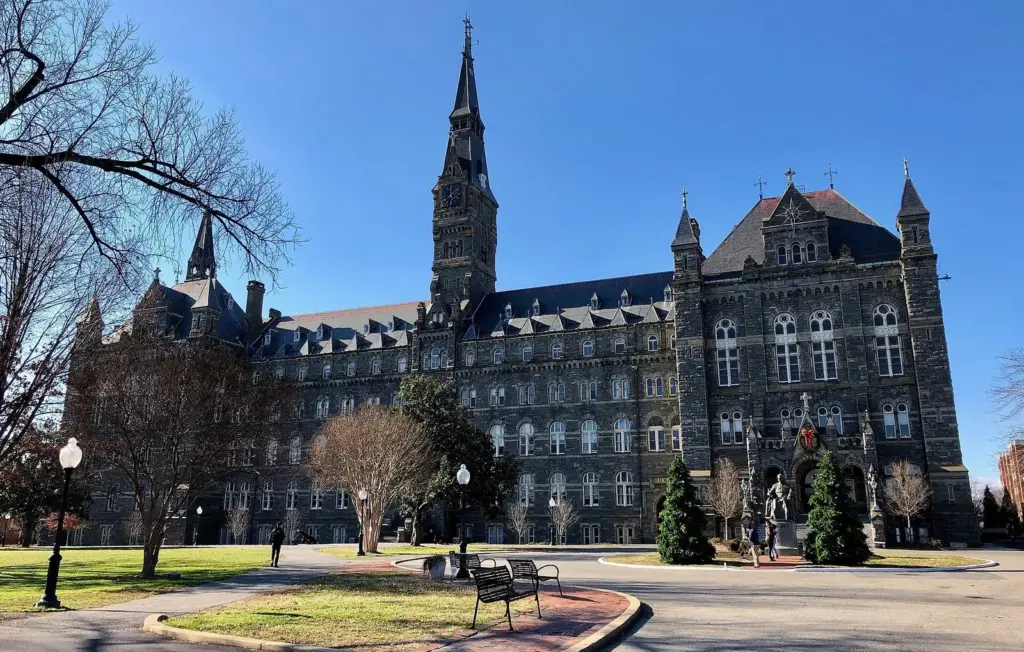
8. Georgetown University’s campus
Free. Founded in 1789, the university fills the western end of Georgetown, and Healy Hall, its spired stone landmark with a clock tower, is visible from across the river. The main gates at 37th and O Streets open onto Healy Lawn. You can walk the grounds, but remember it’s a working campus, so keep to the paths and out of buildings unless they’re open to the public.
Plan it: free to walk the grounds. Main gates at 37th and O Streets NW. Allow 30 to 45 minutes. Best for: prospective students, architecture fans.
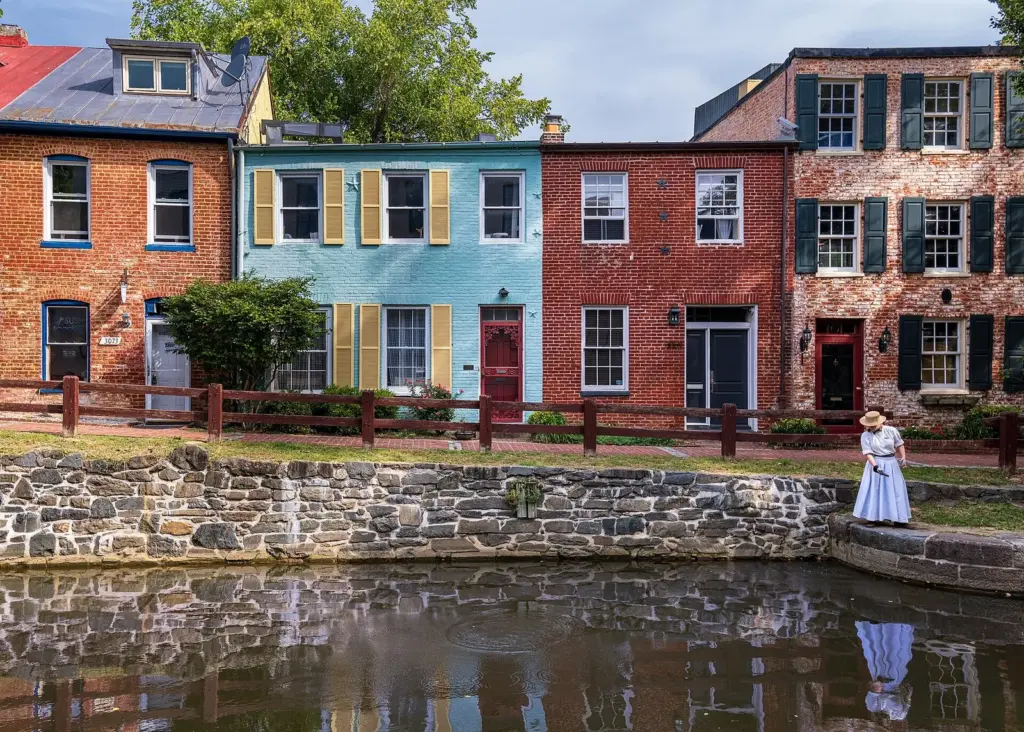
9. N Street, Cox’s Row and the Kennedy houses
Free. The blocks of N Street west of Wisconsin Avenue are Georgetown’s most elegant: Cox’s Row, a set of Federal houses from the early 1800s, and the house at 3307 N Street where John and Jacqueline Kennedy lived before moving to the White House. These are private homes, so admire them from the sidewalk. The walk from here to the university takes ten minutes.
Plan it: free; private homes, sidewalk viewing only. Allow 20 to 30 minutes. Best for: history buffs, architecture fans.
10. Paddle the Potomac from Key Bridge
Paid. Seeing Georgetown from the water is a highlight of a summer visit. The Key Bridge Boathouse, below the bridge, and Thompson Boat Center, at the mouth of Rock Creek, rent kayaks and paddleboards, and it’s a short paddle across to Theodore Roosevelt Island. In September 2026 a single kayak or paddleboard cost $22 on weekdays and $24 on weekends; the Key Bridge Boathouse opened noon to 6pm on weekdays and 9am to 6pm on weekends.
Plan it: seasonal; check the boathouses’ sites for end-of-season dates. Allow 1 to 2 hours. Best for: active travelers, couples, summer days.
11. Take the water taxi
Paid. The Potomac Water Taxi from Washington Harbour runs to the Wharf in about 30 minutes, with connections from the Wharf to Old Town Alexandria, and gives you views of the Kennedy Center, the Lincoln Memorial and the monuments along the way. It’s the most enjoyable way to link Georgetown with the rest of the waterfront.
Plan it: about $22 one way for adults, March to December (as of September 2026). Allow 30 to 60 minutes. Best for: couples, families, sunset.
12. Montrose Park and Dumbarton Oaks Park
Free. At the top of the hill, Montrose Park has lawns, old trees and a playground, and Lovers’ Lane, a walking path, leads down beside it into Dumbarton Oaks Park, a wooded valley that was once part of the estate’s gardens. It’s a surprising slice of wild ground a few minutes from Wisconsin Avenue.
Plan it: free; daylight hours. R Street NW, next to Dumbarton Oaks. Allow 30 minutes to an hour. Best for: families, walkers, a picnic.
13. Book Hill and the galleries on upper Wisconsin
Free. The stretch of Wisconsin Avenue north of P Street, around the Georgetown library, has a cluster of small art galleries and antique shops. It’s quieter and more local than lower Wisconsin, and a good way to finish a walk down from Dumbarton Oaks.
Plan it: free; galleries keep their own hours, often closed early in the week. Allow 30 to 45 minutes. Best for: art lovers, browsers.
14. Oak Hill Cemetery
Free. A 19th-century garden cemetery on terraces above Rock Creek, with a small Gothic Revival chapel by James Renwick, who designed the Smithsonian Castle. It’s peaceful, beautiful in fall, and still a working cemetery, so visit quietly and check its visiting hours before you go.
Plan it: free; limited visiting hours. 3001 R St NW. Allow 30 to 45 minutes. Best for: history buffs, photographers, fall color.
15. The Georgetown cupcake question
Paid. Georgetown Cupcake’s original shop on M Street became famous through its reality-TV show, and on weekends you’ll see the line from down the block. A few minutes’ walk away, Baked & Wired, a family-owned bakery and coffeehouse, sells oversized “cakecups” and has a devoted local following. Try both if you like; the line at Baked & Wired tends to be shorter.
Plan it: both were operating in 2026; check current hours before you go. Allow 15 minutes, or 45 in a weekend line. Best for: families, anyone with a sweet tooth.
A walking route through Georgetown
This loop takes about three hours at a relaxed pace, or a full day with Dumbarton Oaks and Tudor Place. It’s about 3 miles, with one real climb, up to the top of the hill.
- Start at Foggy Bottom-GWU. Walk west on Pennsylvania Avenue, cross Rock Creek, and join M Street.
- Old Stone House (3051 M St), then drop down to the C&O Canal at 30th or 31st Street and walk the towpath west past the locks.
- Climb Wisconsin Avenue past the shops, then turn right onto Q Street and walk east to 31st Street through the quiet upper blocks.
- Tudor Place (31st Street) for a tour, then Dumbarton Oaks (32nd and R Streets) for the museum and, in season, the gardens.
- Montrose Park for a rest, or a detour to Oak Hill Cemetery next door.
- Walk back down through Book Hill on Wisconsin, then west along N Street past Cox’s Row and the Kennedy house at 3307 N Street.
- Georgetown University’s gates at 37th and O Streets, then down to Prospect Street and the Exorcist Steps.
- Finish on the waterfront: walk east through Georgetown Waterfront Park to Washington Harbour for dinner, or take the water taxi to the Wharf at sunset.
A day in Georgetown, hour by hour
The trick to a full Georgetown day is fitting around the opening hours of the two big estates, which don’t line up neatly: Tudor Place’s last house tour starts at 3pm, and the Dumbarton Oaks gardens don’t open until 2pm.
9:30am. Arrive from Foggy Bottom and walk the C&O Canal towpath west from 30th Street while it’s quiet. Stop at the Old Stone House garden on M Street.
11am. Coffee and a pastry at Baked & Wired, then climb Wisconsin Avenue, browsing as you go.
11:30am. The Dumbarton Oaks Museum opens. It’s free, and an hour covers it comfortably.
12:30pm. Lunch on upper Wisconsin Avenue or at Martin’s Tavern.
1:30pm. A guided tour at Tudor Place, booked ahead, on 31st Street.
3pm. Back to Dumbarton Oaks for the gardens, open from 2pm, in season with a timed ticket. Then walk Lovers’ Lane or rest in Montrose Park.
5pm. Stroll down through Book Hill and along N Street past the Kennedy house to the university gates and the Exorcist Steps.
6:30pm. Sunset on the waterfront, dinner at Washington Harbour, and the water taxi back to the Wharf if it’s running.
Outside the garden season, when the Dumbarton Oaks gardens are free and don’t need a ticket, the order is more flexible. And on a Monday, when Tudor Place and Dumbarton Oaks are both closed, make it a canal, waterfront and shopping day instead.
Where to eat in Georgetown
Georgetown has everything from 1930s taverns to waterfront seafood, and the old places are part of the experience. These were all operating in 2026:
- Martin’s Tavern (Wisconsin Avenue at N Street): open since 1933, with wooden booths and a menu of American comfort food. By the tavern’s own account, John F. Kennedy proposed to Jacqueline Bouvier in one of its booths. Good for brunch and a history-soaked lunch.
- 1789 Restaurant (36th Street): a Federal-style rowhouse near the university that has served American fine dining since 1960. It’s the classic special-occasion dinner.
- Fiola Mare (Washington Harbour): Italian seafood on the river, with a terrace and prices to match. Book ahead for a table with a view.
- Filomena Ristorante (Wisconsin Avenue): Italian since 1983, and one of Georgetown’s longest-running restaurants.
- Baked & Wired (Thomas Jefferson Street): the bakery-coffeehouse locals choose, known for its “cakecups” and good coffee.
- Georgetown Cupcake (M Street): the famous one, for the experience as much as the cupcake.
A few tips. Weekend brunch in Georgetown means lines or reservations almost everywhere, so book, or eat at 11am or after 1:30pm. The restaurants at Washington Harbour charge for the river view, and in good weather the terraces are worth it. The cheaper, quicker eating is up Wisconsin Avenue and on the side streets off M Street. For the best tables across the rest of the city, see our guide to the best restaurants in Washington DC.
Shopping in Georgetown
Georgetown is DC’s best-known shopping district, and it’s organized in layers. Lower M Street and lower Wisconsin Avenue hold the national and international brands, from sportswear to fashion to home goods, in historic buildings that make even a chain store feel different. The higher you climb up Wisconsin Avenue, the more independent it gets, with boutiques, antique dealers and the galleries of Book Hill.
For the best experience, shop on a weekday. Weekend afternoons on M Street bring slow sidewalks and long fitting-room lines. DC’s general sales tax is 7 percent from October 1, 2026, up from 6 percent, so budget accordingly. If you’re comparing Georgetown with the rest of the city’s shopping, it wins on atmosphere and variety; it doesn’t win on bargains.
Georgetown for film fans
The Exorcist made Georgetown a film location for good. Beyond the steps, the house where the story is set stands at the top of them on Prospect Street; it’s a private home, so look from the sidewalk. William Peter Blatty, who wrote the novel, was a Georgetown University graduate, which is why he set the story here. The neighborhood has turned up in plenty of other films and TV shows since, most often as shorthand for Washington’s political and social elite, and St. Elmo’s Fire made its main characters recent Georgetown graduates. For most fans, though, one photo at the bottom of those steps is the whole point of the trip.
Georgetown at night
After dark, Georgetown splits in two. M Street and the blocks around Wisconsin Avenue fill with students and a younger crowd heading to bars, while the waterfront at Washington Harbour draws couples to the riverside restaurants and the lit fountains. The residential streets go quiet early. For an evening that isn’t about bars, have dinner on the waterfront, walk the park to Key Bridge, and cross it for a view of Georgetown’s lights reflected in the river. The water taxi back to the Wharf, when it’s running, makes a good end to the night.
Staying in or near Georgetown
Georgetown has a small number of hotels, most of them upscale and close to the canal or the waterfront. Staying here puts the neighborhood at your door, but it also means a walk or a bus ride every time you head to the Mall. Many visitors split the difference and stay in Foggy Bottom or Rosslyn, each about 15 minutes’ walk from M Street and right on the Metro. If you’re mostly here for the museums and monuments, that’s usually the better choice; if Georgetown is the point of the trip, stay in it.
Georgetown through the seasons
Spring is Georgetown’s best season. The gardens at Dumbarton Oaks and Tudor Place are at their peak, the waterfront park comes back to life, and cherry and magnolia trees bloom along the side streets. It’s also when the Dumbarton Oaks gardens’ ticketed season begins, so book ahead.
Summer means kayaks on the river, the fountain at the waterfront park full of kids, and outdoor tables at Washington Harbour. It’s also hot and humid; the towpath’s shade and the river breeze are your friends.
Fall is a close second to spring. The trees along the canal and in Montrose Park and Oak Hill Cemetery turn, the crowds thin after Labor Day, and the Dumbarton Oaks gardens keep their season through October 31, after which they’re free in the winter season. Halloween week brings fans to the Exorcist Steps.
Winter is quiet. The Georgetown Business Improvement District’s GLOW festival of light art, a December and January fixture for nine years, took a hiatus in 2025 while the BID looked for new partners. For 2026-27, check the Georgetown BID’s site before you plan around it. Holiday decorations on M Street and cozy restaurants with fireplaces make a winter visit worthwhile anyway.
Georgetown with kids
Georgetown works well for families if you pick the right pieces. The waterfront park, with its fountain, lawns and river views, is the easiest win. The C&O Canal towpath is flat, traffic-free and good for strollers and scooters. Montrose Park has a playground. Cupcakes are an obvious bribe, and the Exorcist Steps are a fun climb for older kids who don’t know the movie. Skip M Street on a crowded Saturday with a stroller; the narrow sidewalks and brick paving make it hard work. A water taxi ride is a highlight for most children.
Georgetown on a budget
Georgetown looks expensive, and parts of it are, but a great day here can cost very little. The best things are free: the canal towpath, the waterfront park, the Old Stone House garden, the Dumbarton Oaks Museum, the gardens in their free winter season, the university grounds, Montrose Park, the Exorcist Steps and the walk along N Street. Arrive on the Metro and walk, or take a $2.25 bus. Eat lunch at the casual places on upper Wisconsin Avenue and save the waterfront restaurants for a drink at sunset. If you want one paid experience, a Tudor Place tour or a kayak hour on the river gives you the most for the money.
Accessibility in Georgetown
Georgetown is harder going than most of DC. Sidewalks on the side streets are often brick, narrow and heaved up by tree roots, and the northern half of the neighborhood sits up a steep hill. M Street and the waterfront park are the flattest and smoothest parts, and the waterfront is the most accessible stretch overall. The Potomac Water Taxi’s Georgetown dock isn’t ADA compliant, so wheelchair users should plan to arrive another way. Check with Tudor Place and Dumbarton Oaks directly about access to their houses and gardens, since historic buildings and terraced grounds vary room by room.
Is Georgetown worth visiting? Honest advice and what to skip
Yes, especially if you’ve done the Mall and want to see a lived-in, older side of Washington. But it’s worth knowing the downsides.
Skip driving. Traffic on M Street crawls, and parking is expensive and scarce. Walk from the Metro, take a bus, or arrive by water.
Skip the weekend crowds on M Street if you can. On Saturday afternoons it’s shoulder to shoulder. Weekday mornings are calm.
Don’t spend your whole visit on M Street. The chain stores are the least interesting part of Georgetown. The best of it is up the hill and off the main streets: the side streets, the canal and the estates.
Watch your step. Brick sidewalks, tree roots and old cobblestones make for uneven walking. Wear flat, comfortable shoes.
Skip the cupcake line if it’s over half an hour. The cupcakes are good; they’re not that good.
Don’t forget the hill. Dumbarton Oaks, Tudor Place and Montrose Park are at the top of a steep climb. Plan the route so you walk up once and come down.
Georgetown DC FAQ
Is Georgetown DC safe?
Georgetown is one of the busiest and most visited neighborhoods in DC, and for visitors it generally feels safe, day and night. Use normal city sense: keep an eye on bags and phones in crowds on M Street, don’t leave anything visible in a parked car, and stick to lit streets late at night.
Is there a Metro station in Georgetown?
No. The nearest stations are Foggy Bottom-GWU, about a 15-minute walk to M Street, and Rosslyn in Virginia, across Key Bridge. Metrobus lines A58, C91, D80, D82, D94 and D96 serve the neighborhood, and the Potomac Water Taxi runs from the Wharf from March to December.
Which DC airport is closest to Georgetown?
Reagan National Airport is closest, about 5 miles away. By Metro, take the Blue line to Rosslyn and walk across Key Bridge, about 15 minutes. A taxi or rideshare takes around 15 to 20 minutes without traffic. Dulles and BWI are much farther out.
What is Georgetown DC known for?
Georgetown is known for being DC’s oldest neighborhood, with Federal-era rowhouses and cobbled side streets, for shopping on M Street and Wisconsin Avenue, for the C&O Canal and the Potomac waterfront, for Georgetown University, and for historic estates like Dumbarton Oaks and Tudor Place.
How much time do you need in Georgetown?
Half a day covers M Street, the canal, the waterfront and a snack stop. A full day lets you add Dumbarton Oaks, Tudor Place and the walk along N Street to the university. If you’re shopping seriously or want a long lunch and a water taxi at sunset, plan the whole day.
How do you get from the National Mall to Georgetown?
Take the Metro to Foggy Bottom-GWU and walk about 15 minutes, or ride a Metrobus that runs along M Street. You can also walk from the Lincoln Memorial along the river past the Kennedy Center in about 40 minutes, or take the Potomac Water Taxi from the Wharf.
Is Georgetown walkable?
Very, once you’re there. The core is compact, and M Street, the canal and the waterfront are all flat. The northern part, around Dumbarton Oaks and Tudor Place, is up a steep hill. Brick sidewalks can be uneven, so wear comfortable shoes and allow time for the climb.
Is Georgetown GLOW happening in 2026?
Check the BID’s website. The Georgetown Business Improvement District paused GLOW, its winter light-art festival, in 2025 after nine years, while it looked for new partners, so confirm the 2026-27 season there before planning a trip around it.
Related Washington DC Guides
- Best Restaurants in Washington DC: where to eat across the city, beyond Georgetown.
Sources and How We Checked
We checked every hour, fare and price on this page on September 24, 2026 against the official websites below, and compiled the page from them. We don’t claim first-hand visits.
- Georgetown BID: Parking and Getting Here
- Dumbarton Oaks: Hours and Admission
- Tudor Place: Plan Your Visit
- National Park Service: Old Stone House
- National Park Service: C&O Canal boat programs
- Georgetown BID: Georgetown GLOW
We also checked WMATA, Capital Bikeshare, the Potomac Water Taxi, Adventures Unbound and the restaurants’ current listings.
Washington DC Tourism Guide is an independent publication. We are not affiliated with Destination DC, the National Park Service, the Georgetown Business Improvement District or any business listed here, and no one paid to be included.
Photo Credits
- The C&O Canal in Georgetown at dusk: photo by Sdkb, via Wikimedia Commons (CC BY-SA 4.0)
- Key Bridge over the Potomac: photo by G. Edward Johnson, via Wikimedia Commons (CC BY 4.0)
- Georgetown Waterfront Park: photo by APK, via Wikimedia Commons (CC BY-SA 4.0)
- Tudor Place: photo by Wknight94 talk, via Wikimedia Commons (CC BY-SA 3.0)
- The Exorcist Steps, 2026: photo by Sdkb, via Wikimedia Commons (CC BY-SA 4.0)
- Healy Hall, Georgetown University: photo by Warren LeMay from Cincinnati, OH, United States, via Wikimedia Commons (CC0)
- Georgetown rowhouses: photo by Daniel M Horowitz, via Wikimedia Commons (CC BY-SA 4.0)